DEF 14A: Definitive proxy statements
Published on April 30, 2026
c
UNITED STATES
SECURITIES AND EXCHANGE COMMISSION
Washington, D.C. 20549
Proxy Statement Pursuant to Section 14(a) of the Securities
Exchange Act of 1934 (Amendment No. )
Filed by the Registrant ☒
Filed by a Party other than the Registrant ☐
Check the appropriate box:
☐ Preliminary Proxy Statement
☐ Confidential, for Use of the Commission Only (as permitted by Rule 14a-6(e)(2))
☒ Definitive Proxy Statement
☐ Definitive Additional Materials
☐ Soliciting Material Pursuant to §240.14a-12
(Name of Registrant as Specified In Its Charter)
(Name of Person(s) Filing Proxy Statement, if other than the Registrant)
Payment of Filing Fee (Check all boxes that apply):
☒ No fee required
☐ Fee paid previously with preliminary materials
☐ Fee computed on table in exhibit required by Item 25(b) per Exchange Act Rules 14a-6(i)(1) and 0-11

3611 Valley Centre Drive, Suite 150
San Diego, CA 92130
Notice of 2026 Annual Meeting of Stockholders and Proxy Statement
Dear Stockholder:
The 2026 annual meeting of stockholders of Airgain, Inc. will be held on Wednesday, June 10, 2026, at 9:00 a.m., Pacific Time, via a live webcast for the following purposes, as more fully described in the accompanying proxy statement:
We have elected to take advantage of SEC rules that allow companies to furnish proxy materials to their stockholders by providing access to these documents on the Internet instead of mailing printed copies. Those rules allow a company to provide its stockholders with the information they need, while lowering the costs of delivery and reducing the environmental impact of the annual meeting. Most of our stockholders will not receive printed copies of our proxy materials unless requested, but instead will receive a notice with instructions on how they may access and review our proxy materials on the Internet and how they may cast their vote via the Internet. If you would like to receive a printed or e-mail copy of our proxy materials, please follow the instructions for requesting the materials in the Notice of Internet Availability that is being sent to you.
As noted above, our annual meeting will be a virtual meeting of stockholders, conducted solely by remote communication via a live webcast. There will not be a physical meeting location and stockholders will not be able to attend the annual meeting in person. This means that you can attend the annual meeting online, vote your shares during the online meeting, and submit questions for consideration at the online meeting. To be admitted to the annual meeting’s live webcast, you must register at www.proxydocs.com/AIRG by 2:00 p.m. Pacific Time, on June 8, 2026 (the "Registration Deadline"), as described in the Notice of Internet Availability or the proxy card. As part of the registration process you must enter the Control Number included in your Internet notice, your proxy card or on the instructions that accompanied your proxy materials. After completion of your registration by the Registration Deadline further instructions, including a unique link to access the annual meeting, will be emailed to you.
The foregoing items of business are more fully described in the accompanying proxy statement, which forms a part of this notice and is incorporated herein by reference. Our board of directors has fixed the close of business on April 13, 2026, as the record date for the determination of stockholders entitled to notice of and to vote at the annual meeting or any adjournment or postponement thereof.
It is important that your shares be represented regardless of the number of shares you may hold. Whether or not you expect to attend our virtual annual meeting, we urge you to vote your shares as soon as possible via the toll-free telephone number or via the Internet, as described in the Notice of Internet Availability and enclosed proxy materials. If you received a copy of the proxy card by mail, you may sign, date and mail the proxy card in the enclosed return envelope. Promptly voting your shares will ensure the presence of a
1
quorum at the annual meeting and will save us the expense of further solicitation. Submitting your proxy now will not prevent you from voting your shares at the annual meeting if you desire to do so, as your proxy is revocable at your option. For specific voting instructions, please refer to the information provided in the accompanying proxy statement and in the Notice of Internet Availability.
All stockholders are cordially invited to attend the meeting via a live webcast. We appreciate your continued support of the Company.
|
|
By Order of the Board of Directors, |
|
|
|
|
|
/s/ James K. Sims |
|
|
James K. Sims |
|
|
Chair of the Board of Directors |
|
|
|
San Diego, California |
|
|
April 30, 2026 |
|
|
Your vote is important. Please vote your shares whether or not you plan to attend the meeting.
2
Table of Contents
General Information About the 2026 Annual Meeting and Voting |
3 |
9 |
|
Proposal 2: Ratification of Appointment of Independent Registered Public Accounting Firm |
20 |
Proposal 3: Advisory Vote on the Compensation Paid to Our Named Executive Officers |
|
Proposal 4: Approval of Amendment and Restatement of 2016 Incentive Award Plan |
22 |
Security Ownership of Certain Beneficial Owners and Management |
38 |
39 |
|
40 |
|
54 |
|
54 |
|
56 |
|
57 |
|
60 |
Proxy Statement for the 2026 Annual Meeting of Stockholders to Be Held on Wednesday, June 10, 2026
The board of directors of Airgain, Inc. (the "Board") is soliciting the enclosed proxy for use at the Annual Meeting of Stockholders to be held on Wednesday, June 10, 2026, at 9:00 a.m., Pacific Time (the "2026 Annual Meeting"). The 2026 Annual Meeting will be a virtual meeting, which will be conducted via a live webcast. Prior registration to attend the 2026 Annual Meeting at www.proxydocs.com/AIRG is required by 2:00 p.m., Pacific Time, on June 8, 2026 (the "Registration Deadline").
Important Notice Regarding the Availability of Proxy Materials for the Annual Meeting of Stockholders to be Held on Wednesday, June 10, 2026:
This proxy statement and our Annual Report on Form 10-K for the year ended December 31, 2025 (the “2025 Annual Report”) are available electronically at www.proxydocs.com/AIRG.
General Information About the 2026 Annual Meeting and Voting
Why am I receiving these proxy materials?
We have prepared these proxy materials, including this proxy statement and the enclosed proxy card because our Board is soliciting your proxy to vote at the 2026 Annual Meeting. This proxy statement summarizes information related to your vote at the 2026 Annual Meeting. All stockholders who find it convenient to do so are cordially invited to attend the 2026 Annual Meeting via live webcast. However, you do not need to attend the meeting to vote your shares. Instead, you may simply submit your proxy via phone or the Internet in accordance with the instructions provided in the Notice of Internet Availability of Proxy Materials or, if you requested printed copies of the proxy materials by mail, complete, sign, and return the enclosed proxy card.
Notice of Internet Availability of Proxy Materials.
As permitted by Securities and Exchange Commission ("SEC") rules, we are making this proxy statement and our 2025 Annual Report available to our stockholders electronically via the Internet. On or about April 30, 2026, we will mail to our stockholders a Notice of Internet Availability of Proxy Materials (the “Internet Notice”) containing instructions on how to access this proxy statement and our 2025 Annual Report and vote online. If you received an Internet Notice by mail, you will not receive a printed copy of the proxy materials in the mail
3
unless you specifically request them. Instead, the Internet Notice instructs you on how to access and review all of the important information contained in the proxy statement and the 2025 Annual Report. The Internet Notice also instructs you on how you may submit your proxy over the Internet. If you received an Internet Notice by mail and would like to receive a printed copy of our proxy materials, you should follow the instructions for requesting such materials contained on the Internet Notice. We encourage our stockholders to take advantage of the availability of the proxy materials on the Internet to help reduce the environmental impact of our annual meetings and reduce the cost to us associated with the printing and mailing of materials.
Printed Copies of Our Proxy Materials.
If you received printed copies of our proxy materials, then instructions regarding how you can vote are contained on the proxy card included in the materials.
How can I attend the 2026 Annual Meeting?
The 2026 Annual Meeting will be accessible through the Internet via a live webcast. You are entitled to participate in the 2026 Annual Meeting if you were a stockholder as of the close of business on our record date of April 13, 2026, or hold a valid proxy for the meeting. To be admitted to the 2026 Annual Meeting’s live webcast, you must register at www.proxydocs.com/AIRG by the Registration Deadline as described in these proxy materials. As part of the registration process you must enter the Control Number shown on your Internet Notice, your proxy card, or on the instructions that accompanied your proxy materials. If your shares are held in “street name,” you should contact your bank or broker to obtain your Control Number or otherwise vote through the bank or broker. After completion of your registration by the Registration Deadline, further instructions, including a unique link to access the 2026 Annual Meeting, will be emailed to you. This year’s stockholders’ question and answer session will include questions submitted in advance of the 2026 Annual Meeting. You may submit a question in advance of the meeting as a part of the registration process. Questions pertinent to meeting matters and that are submitted in accordance with our Rules of Conduct for the 2026 Annual Meeting will be answered during the meeting, subject to applicable time constraints. Questions and answers may be grouped by topic and substantially similar questions may be grouped and answered once. In order to promote fairness, efficient use of time and in order to ensure responses to all stockholders, we will respond to up to two questions from a single stockholder.
Who can vote at the 2026 Annual Meeting?
Only stockholders of record at the close of business on the record date for the 2026 Annual Meeting, April 13, 2026, are entitled to vote at the 2026 Annual Meeting. At the close of business on this record date, there were 12,675,780 shares of our common stock outstanding. Common stock is our only class of stock entitled to vote.
Stockholders of Record: Shares Registered in Your Name
If, on the record date, your shares were registered directly in your name with the transfer agent for our common stock, American Stock Transfer & Trust Company, then you are a stockholder of record. As a stockholder of record, you may vote at the 2026 Annual Meeting if you attend online or vote by proxy. Whether or not you plan to attend the 2026 Annual Meeting online, we encourage you to vote by proxy via the Internet, by telephone, or by mail, as instructed below to ensure your vote is counted.
Beneficial Owners: Shares Registered in the Name of a Broker or Bank
If, on the record date, your shares were held in an account at a brokerage firm, bank, dealer, or other similar organization, then you are the beneficial owner of shares held in “street name” and this Internet Notice or these proxy materials are being forwarded to you by that organization. The organization holding your account is considered the stockholder of record for purposes of voting at the 2026 Annual Meeting. As a beneficial owner you have the right to direct your broker or other agent on how to vote the shares in your account. As discussed above, if you are a street name stockholder, you are invited to attend and vote your shares at the 2026 Annual Meeting online so long as you register at www.proxydocs.com/AIRG by the Registration Deadline. However, since you are not the stockholder of record, you may be required to request and obtain a valid proxy from your broker, bank, or other agent in order to vote your shares online at the meeting, after following all instructions provided after your successful registration.
4
What am I voting on?
There are four proposals scheduled for a vote:
Proposal 1: To elect two directors to serve as Class I directors for a three-year term to expire at the 2029 annual meeting of stockholders.
Proposal 2: To consider and vote upon the ratification of the appointment of Grant Thornton LLP as our independent registered public accounting firm for the year ending December 31, 2026.
Proposal 3: To consider and vote upon, on an advisory basis, the compensation of our named executive officers as disclosed in this proxy statement pursuant to the compensation disclosure rules of the SEC.
Proposal 4: To approve the amendment and restatement of the 2016 Incentive Award Plan.
How many votes do I have?
Each share of our common stock that you own as of April 13, 2026, entitles you to one vote.
How do I vote?
With respect to the election of directors, you may either vote “For” the nominees to the Board or you may “Withhold” your vote for any nominee to the Board that you specify. With respect to the ratification of the appointment of Grant Thornton LLP as our independent registered public accounting firm, you may vote “For,” “Against” or “Abstain” from voting. With respect to the advisory vote on the compensation of our named executive officers, you may vote “For,” “Against” or “Abstain” from voting. With respect to the approval of the amendment and restatement of the 2016 Incentive Award Plan, you may vote “For,” “Against” or “Abstain” from voting.
Stockholders of Record: Shares Registered in Your Name
If you are a stockholder of record, there are several ways for you to vote your shares. Whether or not you plan to attend the virtual 2026 Annual Meeting, we urge you to vote by proxy prior to the 2026 Annual Meeting to ensure that your vote is counted.
Beneficial Owners: Shares Registered in the Name of a Broker, Bank, or Other Agent
5
If you are a beneficial owner of shares registered in the name of your broker, bank, or other agent, you should have received voting instructions from that organization rather than directly from us. Please check with your bank, broker, or other agent and follow the voting instructions they provide to vote your shares. Generally, you have three options for returning your proxy.
May I revoke my proxy?
If you give us your proxy, you may revoke it at any time before it is exercised. You may revoke your proxy in any one of the three following ways:
Your most recent proxy card or telephone or Internet proxy is the one that is counted. Your attendance at the Annual Meeting by itself will not revoke your proxy.
If your shares are held in street name, you may change or revoke your voting instructions by following the specific directions provided to you by your bank or broker, or you may vote virtually at the Annual Meeting by obtaining a legal proxy from your bank or broker and submitting the legal proxy along with your ballot at the Annual Meeting.
What constitutes a quorum?
The presence at the 2026 Annual Meeting, whether by attendance or by proxy, of holders representing a majority of our outstanding common stock as of April 13, 2026, or 6,337,891 shares, constitutes a quorum at the meeting, permitting us to conduct our business.
What vote is required to approve each proposal?
Proposal 1: Election of Directors. The two nominees who receive the most “For” votes (among votes properly cast at the 2026 Annual Meeting or by proxy) will be elected. Only votes “For” will affect the outcome.
Proposal 2: Ratification of Independent Registered Public Accounting Firm. The ratification of the appointment of Grant Thornton LLP must receive “For” votes from the holders of a majority in voting power
6
of the votes cast affirmatively or negatively on the proposal. Only votes “For” or “Against” will affect the outcome.
Proposal 3: Approval of the Compensation of the Named Executive Officers. The approval of the compensation of the named executive officers must receive “For” votes from the holders of a majority in voting power of the votes cast affirmatively or negatively on the proposal. Only votes “For” or “Against” will affect the outcome.
Proposal 4: Approval of Amendment and Restatement of the 2016 Incentive Award Plan. The approval of the amendment and restatement of the 2016 Incentive Award Plan must receive “For” votes from the holders of a majority in voting power of the votes cast affirmatively or negatively on the proposal. Only votes “For” or “Against” will affect the outcome.
Voting results will be tabulated and certified by the inspector of election appointed for the 2026 Annual Meeting.
How will my shares be voted if I do not specify how they should be voted?
If you are a stockholder of record and you indicate when voting on the Internet or by telephone that you wish to vote as recommended by the Board, then your shares will be voted at the 2026 Annual Meeting in accordance with the Board’s recommendation on all matters presented for a vote at the 2026 Annual Meeting. Similarly, if you sign and return a proxy card but do not indicate how you want to vote your shares for a particular proposal or for all of the proposals, then for any proposal for which you do not so indicate, your shares will be voted in accordance with the Board’s recommendation.
If you are a beneficial owner of shares held in street name and do not provide the organization that holds your shares with specific voting instructions, then the organization that holds your shares may generally vote your shares in their discretion on “routine” matters but cannot vote on “non-routine” matters. If the organization that holds your shares does not receive instructions from you on how to vote your shares on a non-routine matter, that organization will inform the inspector of election that it does not have the authority to vote on that matter with respect to your shares. This is generally referred to as a “broker non-vote.”
What is the effect of withheld votes, abstentions, and broker non-votes?
Shares of common stock held by persons attending the virtual 2026 Annual Meeting but not voting and shares represented by proxies that reflect withheld votes or abstentions as to a particular proposal will be counted as present for purposes of determining the presence of a quorum. Abstentions are not an affirmative or negative vote on a proposal, so abstaining does not count as a vote cast and has no effect for purposes of determining whether our stockholders have ratified the appointment of Grant Thornton LLP, our independent registered public accounting firm, whether our stockholders have approved the compensation of the named executive officers, or whether our stockholders have approved the amendment and restatement of the 2016 Incentive Award Plan. The election of directors is determined by a plurality of votes cast, so a “Withhold” vote will not be counted in determining the outcome of such proposal.
Shares represented by proxies that reflect a “broker non-vote” will be counted as present for purposes of determining whether the presence of a quorum exists. As discussed above, a “broker non-vote” occurs when a nominee holding shares for a beneficial owner has not received instructions from the beneficial owner and does not have discretionary authority to vote the shares for certain non-routine matters. With regard to the election of directors, the advisory vote to approve the compensation of the named executive officers and the proposal to approve the amendment and restatement of the 2016 Incentive Award Plan, which are considered non-routine matters, broker non-votes will not be counted as votes cast and will have no effect on the result of the vote. However, ratification of the appointment of Grant Thornton LLP is considered a routine matter on which a broker or other nominee has discretionary authority to vote. Accordingly, no broker non-votes will likely result from this proposal.
How does the Board recommend that I vote?
The Board recommends that you vote:
7
If you vote via the Internet, by telephone, or sign and return the proxy card by mail but do not make specific choices, your shares, as permitted, will be voted as recommended by our Board. If any other matter is presented at the 2026 Annual Meeting, your proxy will vote in accordance with his or her best judgment. As of the date of this proxy statement we know of no matters that need to be acted on at the 2026 Annual Meeting, other than those discussed in this proxy statement.
Who is paying the costs of soliciting these proxies?
We will pay all costs of soliciting these proxies. Our directors, officers, and other employees may solicit proxies in person or by mail, telephone, fax, or email. We will not pay our directors, officers, and other employees any additional compensation for these services. We will ask banks, brokers, and other institutions, nominees, and fiduciaries to forward these proxy materials to their principals and to obtain authority to execute proxies. We will then reimburse them for their expenses. Our costs for forwarding proxy materials will not be significant.
Stockholders may obtain our proxy statement (and any amendments and supplements thereto) and other documents as and when filed by the Company with the SEC without charge from the SEC’s website at: www.sec.gov.
How do I obtain a 2025 Annual Report?
If you would like a copy of our 2025 Annual Report filed with the SEC on February 26, 2026, we will send you one without charge. Please write to:
Airgain, Inc.
3611 Valley Centre Drive, Suite 150
San Diego, CA 92130
Attn: Corporate Secretary
All of our SEC filings are also available free of charge in the “Company—Investor Relations—SEC Filings” section of our website at www.airgain.com.
How can I find out the results of the voting at the 2026 Annual Meeting?
Preliminary voting results will be announced at the 2026 Annual Meeting. Final voting results will be published in our current report on Form 8-K to be filed with the SEC within four business days after the 2026 Annual Meeting. If final voting results are not available to us in time to file a Form 8-K within four business days after the meeting, we intend to file a Form 8-K to publish preliminary results and, within four business days after the final results are known to us, file an additional Form 8-K to publish the final results.
8
Proposal 1: Election of Directors
Our Board is divided into three classes, with one class of our directors standing for election each year, generally for a three-year term. Directors for each class are elected at the annual meeting of stockholders held in the year in which the term for their class expires and hold office until the third annual meeting following election and until such director’s successor is elected and qualified, or until such director’s earlier death, resignation, or removal. As detailed in the section below, the current composition of our Board is as follows: Class I consists of James K. Sims and Tzau-Jin Chung; Class II consists of Joan H. Gillman and Arthur M. Toscanini; and Class III consists of Kiva A. Allgood, Thomas A. Munro, and Jacob Suen.
Our Board believes that there is no single approach to corporate governance that is appropriate for all companies and that the key consideration in determining whether to implement a particular governance practice is whether that practice promotes the interests of stockholders, taking into account the specific circumstances of Airgain. The Board has reviewed the rationale for its current classified structure and continues to believe that a classified Board is the appropriate Board structure for Airgain at this time and is in the best interest of our stockholders for the reasons set forth below:
Long-Term Focus |
|
|
The Board believes that a classified Board encourages directors to look to the long-term best interests of Airgain and our stockholders by strengthening the independence of non-employee directors against the often short-term focus of certain investors and special interests. |
|
|
|
|
Continuity of Board Leadership |
|
|
A classified Board allows for a greater amount of stability and continuity, providing institutional perspective and knowledge both to management and other directors in a time of growth and transformation for Airgain. By its very nature, a classified Board ensures that at any given time there will be experienced directors serving on our Board who are fully immersed in and knowledgeable about our highly technical business, including our relationships with our current and potential strategic partners, as well as the competition, opportunities, risks and challenges that exist in our industry. Each year the nominating and corporate governance committee reviews the qualifications and performance of the directors prior to nominating them to stand for election. We believe the benefit of a classified Board to Airgain and our stockholders comes from the continuity of highly qualified, engaged and knowledgeable directors. |
|
|
|
|
Unsolicited Takeover Protection |
|
|
A classified Board can reduce vulnerability to potential abusive takeover tactics by encouraging persons seeking control of Airgain to negotiate with the Board and thereby better positioning the Board to negotiate effectively on behalf of all stockholders. Because less than a majority of directors stand for election at each annual meeting under a classified Board structure, a hostile bidder could not simply replace a majority of the Board at a single annual meeting with directors aligned with the hostile bidder’s own interests, thereby gaining control of Airgain without paying a fair market price to all stockholders. Rather, in the interests of fairness to stockholders as a whole, having a classified Board encourages the hostile bidder to negotiate directly with the Board on a potential transaction. |
At this meeting, two nominees for director are to be elected as Class I directors for a three-year term expiring at our 2029 annual meeting of stockholders and until their successors are duly elected and qualified. The nominees who were recommended for nomination by the nominating and corporate governance committee of our Board are Mr. Chung and Mr. Sims. The Class II directors have one year remaining on their terms of office and the Class III directors have two years remaining on their term of office.
If no contrary indication is made, proxies in the accompanying form are to be voted for Mr. Chung and Mr. Sims, or in the event that Mr. Chung and Mr. Sims is not a candidate or is unable to serve as a director at the
9
time of the election (which is not currently expected), for any nominee who is designated by our Board to fill the vacancy. Mr. Chung and Mr. Sims are current members of our Board.
All our directors bring to the Board significant leadership experience derived from their professional experience and service as executives or board members of other corporations and/or private equity and venture capital firms. The process undertaken by the nominating and corporate governance committee in recommending qualified director candidates is described below under “Board Qualifications and Director Nomination Process.” Certain individual qualifications and skills of our directors that contribute to the Board’s effectiveness as a whole are described in the following paragraphs.
Information Regarding Directors
The information set forth below as to the directors and nominees for director has been furnished to us by the directors and nominees for director:
Nominees for Election to the Board
For a three-year term expiring at the |
||||
2029 Annual Meeting of Stockholders (Class I) |
||||
|
|
|
|
|
Name |
Age |
|
Present position with Airgain, Inc. |
|
James K. Sims |
|
79 |
|
Chair of the Board of Directors |
Tzau-Jin Chung |
|
63 |
|
Director |
James K. Sims has served as our Chair of the board of directors since November 2003. Mr. Sims previously served as our Chief Executive Officer from March 2019 to August 2019, as our interim Chief Executive Officer from May 2018 to March 2019 and as our Executive Chair from October 2018 to March 2019. Mr. Sims has served as the Chair and Chief Executive Officer of GEN3 Partners, a consulting company that specializes in science-based technology development, since 1999, and as Managing Partner of its affiliated private equity investment fund, GEN3 Capital, LLP, since 2005. In 2017, Mr. Sims was the founding partner of Silicon Valley Data Capital and founded Silicon Valley Data Science in 2012, where he is currently the Chair. Mr. Sims also founded Cambridge Technology Partners in 1991 where he held the position of Chief Executive Officer. Prior to Cambridge Technology Partners, Mr. Sims also founded Concurrent Computer Corporation. Mr. Sims currently serves on the boards of directors of GBank, Financial Holdings Inc. (OTCQX: GBFH) and various private companies including Connections 365, Inc., Bright Volt, Inc., and Merritt Hotel.
Mr. Sims’ extensive experience as a director of several public and private companies, as well as his extensive experience as a founder and venture capital investor in the technology industry, contributed to our Board's conclusion that he should serve as a director of our Company.
TJ Chung has served on our Board since October 2018. Mr. Chung is currently a Senior Founding Partner at Core Industrial Partners LLC, a private equity firm investing in North American lower middle-market industrial technology and manufacturing businesses, a position he has held since July 2017. From January 2013 until his retirement in May 2016, Mr. Chung served as Chief Executive Officer of TeletracNavman, a leading global SaaS provider of commercial telematics solutions. From July 2007 to December 2012, Mr. Chung was Chief Executive Officer of Navman Wireless. Previously, Mr. Chung served as President of the New Technologies Division of Brunswick Corporation from 2002 to 2007. Prior to that he served as Chief Strategy Officer of Brunswick Corporation and Senior Vice President of Brunswick Corporation’s Mercury Marine Division. Before joining Brunswick Corporation, Mr. Chung was an executive at Emerson Electric. Mr. Chung currently serves on the boards of directors of Littelfuse, Inc. and Fathom Digital Manufacturing Corp. Mr. Chung earned his bachelor’s degree in science with honors, electrical and computer engineering from the University of Texas at Austin. He also holds a MS in computer science from North Carolina State University and an MBA from the Fuqua School of Business at Duke University.
Mr. Chung’s extensive experience as an operating executive in the telecommunications, wireless, and technology industries contributed to our Board’s conclusion that he should serve as a director of our Company.
10
Members of the Board Continuing in Office
Term expiring at the |
||||
2027 Annual Meeting of Stockholders (Class II) |
||||
|
|
|
|
|
Name |
Age |
|
Present position with Airgain, Inc. |
|
Joan H. Gillman |
|
62 |
|
Director |
Arthur M. Toscanini |
|
83 |
|
Director |
Joan H. Gillman has served on our Board since November 2016. Ms. Gillman joined our board following 10 years as Executive Vice President and Chief Operating Officer of Time Warner Cable Media, a subsidiary of Time Warner Cable. She currently serves on the board of directors of InterDigital, Inc. (NASDAQ: IDCC) and previously served on the boards of directors of Cumulus Media Inc. (NASDAQ: CMLS) and Centrica PLC in the United Kingdom, and of privately held companies such as BIA Communications (Boldyn Networks), Transit Wireless LLC, BlackArrow LLC and National Cable Communications. Prior to Time Warner Cable, Ms. Gillman served in senior executive roles at OpenTV Corporation, British Interactive Broadcasting Holdings Limited and Physicians’ Online Inc., and served as State Director and Legislative Director in the Office of U.S. Senator Chris Dodd. She holds a BA in English from College of the Holy Cross and an MA in Legislative Affairs from George Washington University.
Ms. Gillman’s extensive experience as an operating executive in the cable and technology industries, as well as her service as a director of numerous public and private companies, contributed to our Board's conclusion that she should serve as a director of our Company.
Arthur M. Toscanini has served on our Board since 2005. Mr. Toscanini is the Chief Financial Officer of GEN3 Partners, a position he has held since 2000. Prior to GEN3 Partners, he was with Cambridge Technology Partners from 1991 to 2000, where he served as the Chief Financial Officer. Mr. Toscanini also served as Vice President and Controller of Concurrent Computer Corporation from 1986 to 1991. Prior to Concurrent Computer Corporation, he worked at Perkin- Elmer Data Systems Group. He holds a BA in accounting from Pace University and an MA in management from Monmouth University.
Mr. Toscanini’s extensive knowledge of our business and experience as a chief financial officer contributed to our Board’s conclusion that he should serve as a director of our Company.
Term expiring at the |
||||
2028 Annual Meeting of Stockholders (Class III) |
||||
|
|
|
|
|
Name |
Age |
|
Present position with Airgain, Inc. |
|
Jacob Suen |
|
52 |
|
Director, President and Chief Executive Officer |
Kiva A. Allgood |
|
53 |
|
Director |
Thomas A. Munro |
|
69 |
|
Director |
Jacob Suen has served on our Board and as Chief Executive Officer since August 2019 and as our President since January 2019. He previously served as our Senior Vice President, Worldwide Sales from May 2017 through January 2019. Mr. Suen started with the Company in April 2006 as the Vice President of Asia Pacific Sales. He previously served as the Director of Business Development from 1998 to 2005 at Paradyne Corporation. Prior to Paradyne, Mr. Suen was a development engineer at GVN Technologies in 1998. From 1997 to 1998 Mr. Suen was a software development engineer for Motorola, Inc. Mr. Suen received his MBA from the University of Colorado, MS in Management from the University of South Florida, and BS in Computer and Electrical Engineering from the University of Florida.
Mr. Suen’s extensive technical background in communication, product knowledge, extensive experience in the industries we operate and experience at our business contributed to our Board’s conclusion that he should serve as a director of our Company.
Kiva A. Allgood has served on our Board since July 2021. Ms. Allgood was the President and Chief Executive Officer of Sarcos Technology and Robotics Corporation (now known as Palladyne AI Corp. (NASDAQ: PDYN)), a manufacturer of advanced robotic systems, from December 2021 to June 2023, and
11
prior to that served as Global Head of IoT and Automotive for Ericsson (NASDAQ: ERIC), a global provider of communications technology, from April 2019 to July 2021. Previously, she served as Chief Commercial Development Officer, GE Business Innovations and as Managing Director, GE Ventures for GE Ventures and Business Innovation, a corporate venture company and innovation group of General Electric Company (NYSE: GE). Ms. Allgood also served as President, Qualcomm Intelligent Solutions and Vice President, New Business Development for Qualcomm Incorporated (NASDAQ: QCOM), a global provider of foundational technologies and products used in mobile devices and other wireless products. Ms. Allgood previously served on the boards of directors of Synaptics Incorporated (NASDAQ: SYNA) and Sarcos Technology. Since December 2023, Ms. Allgood has been with the World Economic Forum as the Head of the Centre for Advanced Manufacturing and Supply Chains and a Member of the Executive Committee. Ms. Allgood has an MBA from the Kellogg School of Management at Northwestern University and a Bachelor of Science degree from Northwestern University.
Ms. Allgood’s extensive experience as an operating executive in the communications technology industries contributed to our Board’s conclusion that she should serve as a director of our Company.
Thomas A. Munro has served on our Board since 2004. Mr. Munro was the Chief Executive Officer of Verimatrix, Inc., an internet security technology company, a position he held from April 2005 to March 2019. Prior to Verimatrix, Mr. Munro was the President of Wireless Facilities, Inc. from 2001 to 2003 and Chief Financial Officer from 1997 to 2001. Previously he was the Chief Financial Officer of Precision Digital Images from 1994 to 1995 and of MetLife Capital Corporation from 1992 to 1994. Mr. Munro has previously served on the boards of directors of private companies Kineticom, Inc., CommNexus, Shadowbox and BandwidthX. Mr. Munro holds a BA in business and an MBA from the University of Washington.
Mr. Munro’s extensive knowledge of our business and history and experience in the wireless technology industry contributed to our Board’s conclusion that he should serve as a director of our Company.
Board Independence
Our Board currently consists of seven members. Our Board has determined that all of our directors are independent directors within the meaning of the applicable Nasdaq Stock Market LLC ("Nasdaq") listing standards, except for Mr. Suen, our President and Chief Executive Officer. The Nasdaq independence definition includes a series of objective tests, including that the director is not, and has not been for at least three years, one of our employees and that neither the director nor any of his/her family members has engaged in various types of business dealings with us. In addition, as required by Nasdaq rules, our Board has made a subjective determination as to each independent director that no relationships exist which, in the opinion of our Board, would interfere with the exercise of independent judgment in carrying out the responsibilities of a director. In making these determinations, our Board reviewed and discussed information provided by the directors and us with regard to each director’s business and personal activities and relationships as they may relate to us and our management. There are no family relationships among any of our directors or executive officers.
Board Leadership Structure
Our Board is currently led by its Chair, James K. Sims. Our Board recognizes that it is important to determine an optimal board leadership structure to ensure independent oversight of management as the Company continues to grow.
Pursuant to our Corporate Governance Guidelines, the Board determines the best board leadership structure for our Company from time to time. As part of our annual Board self-evaluation process, we evaluate our leadership structure to ensure that the Board continues to believe that it provides the optimal structure for our Company and stockholders. We recognize that different board leadership structures may be appropriate for companies in different situations. We believe our current leadership structure is the optimal structure for our Company at this time.
Each of the directors, other than Mr. Suen, is independent, and the Board believes that the independent directors provide effective oversight of management. Moreover, in addition to feedback provided during Board meetings, the independent directors have regular executive sessions. Following an executive session of independent directors, the independent directors communicate with Mr. Suen directly regarding any specific feedback or issues, provide Mr. Suen with input regarding agenda items for Board and Board
12
committee meetings, and coordinate with Mr. Suen regarding information to be provided to the independent directors in performing their duties. The Board believes that this approach appropriately and effectively complements the combined Chief Executive Officer/Director structure.
Role of Board in Risk Oversight Process
Our Board has responsibility for the oversight of the Company’s risk management processes and, either as a whole or through its committees, regularly discusses with management our major risk exposures, their potential impact on our business, and the steps we take to manage them. The risk oversight process includes receiving regular reports from Board committees and members of senior management to enable our Board to understand the Company’s risk identification, risk management, and risk mitigation strategies with respect to areas of potential material risk, including operations, finance, legal, regulatory, strategic, and reputational risk.
The audit committee reviews information regarding liquidity and operations and oversees our management of financial risks. Periodically the audit committee reviews our policies with respect to risk assessment, risk management, loss prevention, and regulatory compliance. Oversight by the audit committee includes direct communication with our external auditors and discussions with management regarding significant risk exposures and the actions management has taken to limit, monitor, or control such exposures. The compensation committee is responsible for assessing whether any of our compensation policies or programs has the potential to encourage excessive risk-taking. While each committee is responsible for evaluating certain risks and overseeing the management of such risks, the entire Board is regularly informed through committee reports about such risks. Matters of significant strategic risk are considered by our Board as a whole.
Board Meetings
During 2025, our Board met seven times. In 2025, each director attended at least 92% of the total number of meetings held during such director’s term of service by the Board and each committee of the Board on which such director served.
Board Committees and Independence
Our Board has established three standing committees: audit, compensation, and nominating and corporate governance, each operating under a charter that has been approved by our Board. The table below provides current committee membership information for each of the Board committees.
|
Committees |
||
Name |
Audit |
Compensation |
Nominating and Corporate Governance |
James K. Sims |
|
X |
|
Kiva A. Allgood |
|
|
X |
Tzau-Jin Chung |
|
X |
|
Joan H. Gillman |
X |
|
Chair |
Thomas A. Munro |
X |
Chair |
|
Arthur M. Toscanini |
Chair |
|
|
Number of committee meetings held in 2025 |
4 |
3 |
1 |
Audit Committee
The audit committee’s main function is to oversee our accounting and financial reporting processes and the audits of our financial statements. This committee’s responsibilities include, among other things:
13
Our Board has determined that all members of the audit committee are independent directors under the applicable rules and regulations of Nasdaq and by Rule 10A-3 of Securities and Exchange Act of 1934, as amended (the "Exchange Act"). In addition, all members of our audit committee meet the requirements for financial literacy under the applicable rules and regulations of the SEC and Nasdaq. Our Board has determined that each of Mr. Toscanini and Mr. Munro is an “audit committee financial expert” as defined by applicable SEC rules and has the requisite financial sophistication as defined under the applicable Nasdaq rules and regulations. Both our external auditor and internal financial personnel meet privately with the audit committee and have unrestricted access to this committee. The audit committee operates under a written charter that satisfies the applicable standards of the SEC and Nasdaq, which the audit committee will review and evaluate at least annually.
Compensation Committee
The compensation committee approves or recommends to our Board, policies and programs relating to compensation and benefits of our officers and employees. The compensation committee (a) approves or recommends to our Board annual corporate goals and objectives relevant to the compensation of our Chief Executive Officer and other executive officers, (b) evaluates the performance of these officers relative to those goals and objectives, (c) approves or recommends to our Board the compensation of these officers, and (d) approves or recommends to our Board the issuance of equity awards under our equity plan.
Our Board has determined that all members of the compensation committee are independent under the applicable rules and regulations of Nasdaq relating to compensation committee independence and “non-employee directors” as defined in Rule 16b-3 promulgated under the Exchange Act. The compensation committee operates under a written charter which the compensation committee will review and evaluate at least annually.
Nominating and Corporate Governance Committee
The nominating and corporate governance committee is responsible for assisting our Board in discharging its responsibilities regarding the identification of qualified candidates to become members of our Board, the selection of nominees for election as directors at our annual meeting of stockholders (or special meeting of stockholders at which directors are to be elected), and the selection of candidates to fill any vacancies on our Board and any committees thereof. In addition, the nominating and corporate governance committee is responsible for overseeing our corporate governance policies, reporting and making recommendations to our Board concerning governance matters and oversight of the evaluation of our Board.
14
Our Board has determined that all members of the nominating and corporate governance committee are independent under the applicable rules and regulations of Nasdaq. The nominating and corporate governance committee operates under a written charter which the nominating and corporate governance committee will review and evaluate at least annually.
Compensation Committee Interlocks and Insider Participation
None of the members of our compensation committee during 2025 has ever been one of our officers or employees, other than Mr. Sims who served as our Chief Executive Officer from March 2019 to August 2019, our interim Chief Executive Officer from May 2018 to March 2019, and our Executive Chair from October 2018 to March 2019 (Mr. Sims was not a member of our compensation committee during any of such periods). None of our executive officers currently serves, or has served, as a member of the Board or compensation committee of any entity that has one or more executive officers who have served as a member of our Board or compensation committee.
Board Qualifications and Director Nomination Process
Director Qualifications
Our nominating and corporate governance committee is responsible for reviewing with the Board, on an annual basis, the appropriate skills, experience and characteristics required for the Board as a whole and its individual members. In evaluating the suitability of individual candidates (both new candidates and current members), the nominating and corporate governance committee, in recommending candidates for election, and the Board, in approving (and, in the case of vacancies, appointing) such candidates, will consider personal and professional integrity, and ethics along with other factors the committee may deem to be relevant, such as:
Currently our Board evaluates each individual in the context of the Board as a whole, with the objective of assembling a group that can best maximize the success of the business and represent stockholder interests through the exercise of sound judgment using its range of experience in these various areas.
Other than the foregoing there are no stated minimum criteria for director nominees, although the nominating and corporate governance committee may also consider such other factors as it may deem to be in the best interests of our Company and our stockholders. The nominating and corporate governance committee does, however, believe it appropriate for at least one, and preferably, multiple members of our Board to meet the criteria for an “audit committee financial expert” as defined by SEC rules, and that a majority of the members of our Board meet the definition of “independent director” under Nasdaq qualification standards. The nominating and corporate governance committee also believes it is appropriate for our Chief Executive Officer and President to serve as a member of our Board.
Identification and Evaluation of Nominees for Directors
The nominating and corporate governance committee identifies nominees for directors by first evaluating the current members of our Board willing to continue in service. Current members with qualifications and skills that are consistent with the nominating and corporate governance committee’s criteria for board of director service and who are willing to continue in service are considered for re-nomination while, at the
15
same time, balancing the value of continuity of service by existing members of our Board with that of obtaining a new perspective or expertise.
If any member of our Board does not wish to continue in service, if our Board decides not to re-nominate a member for re-election, or if the Board decides to expand the size of the Board, the nominating and corporate governance committee identifies the desired skills and experience of a new nominee in light of the criteria above. The nominating and corporate governance committee generally polls our Board and members of management for their recommendations. The nominating and corporate governance committee may also review the composition and qualification of the boards of directors of our competitors and may seek input from industry experts or analysts. The nominating and corporate governance committee reviews the qualifications, experience, and background of the candidates. Final candidates are interviewed by the members of the nominating and corporate governance committee and by certain of our other independent directors and executive management. In making its determinations the nominating and corporate governance committee evaluates each individual in the context of our Board as a whole, with the objective of assembling a group that can best contribute to the success of our Company and represent stockholder interests through the exercise of sound business judgment. After reviewing and deliberation of all feedback and data, the nominating and corporate governance committee makes its recommendation to our Board.
The nominating and corporate governance committee evaluates nominees recommended by stockholders in the same manner as it evaluates other nominees. We have not received director candidate recommendations from our stockholders and we do not have a formal policy regarding consideration of such recommendations. However, any recommendations received from stockholders will be evaluated in the same manner that potential nominees suggested by members of our Board, management, or other parties are evaluated.
Under our amended and restated bylaws, a stockholder wishing to suggest a candidate for director should write to our corporate secretary and provide such information about the stockholder and the proposed candidate as is set forth in our amended and restated bylaws and as would be required by SEC rules to be included in a proxy statement. In addition, the stockholder must include the consent of the candidate and describe any arrangement or undertakings between the stockholder and the candidate regarding the nomination. In order to give the nominating and corporate governance committee sufficient time to evaluate a recommended candidate and include the candidate in our proxy statement for the 2027 annual meeting, the recommendation should be received by our corporate secretary at our principal executive offices in accordance with our procedures detailed in the section below entitled “Stockholder Proposals.”
Director Attendance at Annual Meetings
Although we do not have a formal policy regarding attendance by members of our Board at our annual meeting, we encourage all of our directors to attend. Five members of our Board at the time attended our annual meeting of stockholders in 2025.
Communications with our Board
Stockholders seeking to communicate with our Board should submit their written comments to our corporate secretary, Airgain, Inc., 3611 Valley Centre Drive, Suite 150, San Diego, CA 92130. The corporate secretary will forward such communications to each member of our Board; provided that, if in the opinion of our corporate secretary it would be inappropriate to send a particular stockholder communication to a specific director, such communication will only be sent to the remaining directors (subject to the remaining directors concurring with such opinion).
Insider Trading Policy and Prohibition Against Pledging and Hedging
We have
In addition, our Insider Trading Policy prohibits our officers, directors, and employees pledging our stock as collateral to secure loans and from engaging in hedging transactions, including prepaid variable forward
16
contracts, equity swaps, collars and exchange funds. It further prohibits margin purchases of our stock or placing our stock in a margin account, short sales of our stock, and any transactions in puts, calls, or other derivative securities involving our stock.
Corporate Governance
Our Company’s Code of Business Conduct and Ethics, Corporate Governance Guidelines, Audit Committee Charter, Compensation Committee Charter, and Nominating and Corporate Governance Committee Charter are available, free of charge, on our website at www.airgain.com. Please note, however, that the information contained on the website is not incorporated by reference in, or considered part of, this proxy statement. We will also provide copies of these documents as well as our Company’s other corporate governance documents, free of charge, to any stockholder upon written request to Airgain, Inc., 3611 Valley Centre Drive, Suite 150, San Diego, CA 92130, Attention: Corporate Secretary.
Director Compensation
Our Board has approved a compensation policy for our non-employee directors. The non-employee director compensation policy provides annual retainer fees and long-term equity awards for our non-employee directors. Pursuant to the terms of the non-employee director compensation policy, each non-employee director, other than the Chair, will receive an annual retainer of $32,000. Our Chair of the Board receives an annual retainer of $58,500. Non-employee directors serving as the chairs of the audit, compensation, and nominating and corporate governance committees will receive additional annual retainers of $16,000, $10,600, and $8,000, respectively. Non-employee directors serving as members of the audit, compensation, and nominating and corporate governance committees will receive additional annual retainers of $8,000, $5,300 and $4,000, respectively.
During 2025, our non-employee directors elected to receive their quarterly retainers for the third and fourth quarters of 2025 in the form of fully-vested shares. The shares issued in respect of the directors’ third quarter retainers were granted on October 1, 2025, and the shares issued in respect of the directors’ fourth quarter retainers were granted on January 2, 2026. The number of shares issued was determined by dividing the applicable quarterly cash retainer by the thirty-trading day trailing average closing price of our common stock preceding the grant date (the “Thirty-Day Trailing Average”).
Each non-employee director who is newly elected or appointed to the Board will also receive, effective on the date of such election or appointment (or such other date specified by the Board), (1) an initial grant of options to purchase a number of shares of our common stock having a value of $50,000, calculated as of the date of grant in accordance with the Black-Scholes option pricing model (utilizing the same assumptions that we utilize in preparation of our financial statements and the thirty calendar day trailing average trading price of our common stock preceding the date of grant, plus (2) such number of restricted stock units (RSUs) as is determined by dividing (A) $50,000 by (B) the Thirty-Day Trailing Average, which initial awards will vest in substantially equal installments on each of the first three anniversaries of the date of grant. Non-employee director’s initial awards shall vest in full immediately prior to the occurrence of a change in control, to the extent outstanding at such time.
Each non-employee director will receive an annual award on the first trading day in February of each year of (1) a number of stock options having a value of $30,000 (with the award to the Chair of the Board having a value of $45,000), calculated as of the date of grant in accordance with the Black-Scholes option pricing model (utilizing the same assumptions that we use in preparation of our financial statements and the Thirty-Day Trailing Average), plus (2) such number of RSUs as is determined by dividing (A) $30,000 (with the award to the Chair of the Board having a value of $45,000) by (B) the Thirty-Day Trailing Average, which annual awards will vest on the first anniversary of the date of grant. All of the non-employee directors' awards shall vest in full immediately prior to the occurrence of a change in control, to the extent outstanding at such time.
In addition, the non-employee director compensation policy contains an ownership guideline requiring members of the Board to own shares with a value of at least three times the then-current annual retainer. A newly appointed director is subject to this guideline within three years after the director’s first appointment to the Board. Compensation under our compensation policy is subject to the annual limits on non-employee director compensation set forth in our 2016 Incentive Award Plan, referred to herein as the 2016 Plan. Our Board or its authorized committee may modify the non-employee director compensation policy from time to time in the exercise of its business judgment, considering such factors and circumstances as it shall deem
17
relevant from time to time, subject to the annual limit on non-employee director compensation set forth in the 2016 Plan. As provided in the 2016 Plan, our Board or its authorized committee may make exceptions to this limit for individual non-employee directors in extraordinary circumstances, as the Board or its authorized committee may determine in its discretion, provided that the non-employee director receiving such additional compensation may not participate in the decision to award such compensation or in other compensation decisions involving non-employee directors.
Mr. Suen, who serves as our President and Chief Executive Officer and a member of our Board receives no additional compensation for his service as a director.
The following table sets forth information for the year ended December 31, 2025, regarding the compensation awarded to, earned by, or paid to our non-employee directors who served on our Board during 2025:
Name |
|
Fees earned or paid in cash(1) |
|
Option |
|
Stock |
|
All other |
|
Total |
|
|||||
Kiva A. Allgood |
|
$ |
36,000 |
|
$ |
28,820 |
|
$ |
37,852 |
|
$ |
— |
|
$ |
102,673 |
|
Tzau-Jin Chung |
|
$ |
37,300 |
|
$ |
28,820 |
|
$ |
38,179 |
|
$ |
— |
|
$ |
104,299 |
|
Joan H. Gillman |
|
$ |
48,000 |
|
$ |
28,820 |
|
$ |
40,846 |
|
$ |
— |
|
$ |
117,667 |
|
Thomas A. Munro |
|
$ |
50,600 |
|
$ |
28,820 |
|
$ |
41,495 |
|
$ |
— |
|
$ |
120,915 |
|
James K. Sims |
|
$ |
63,800 |
|
$ |
43,231 |
|
$ |
59,231 |
|
$ |
— |
|
$ |
166,261 |
|
Arthur M. Toscanini |
|
$ |
48,000 |
|
$ |
28,820 |
|
$ |
40,846 |
|
$ |
— |
|
$ |
117,667 |
|
(1) Includes the dollar value of the quarterly cash retainers that the non-employee directors elected to receive in the form of fully-vested shares. To the extent the grant-date fair value of the fully-vested shares issued in satisfaction of such retainers exceeded the dollar value of such quarterly retainers, the incremental amount is reflected in the “Stock Awards” column in the table above. The table below shows the numbers of fully-vested shares issued to each non-employee director listed for the third and fourth quarter retainers and the corresponding cash retainers paid in shares:
Name |
|
Q3 2025 |
|
Q4 2025 |
|
||||||||||||||
|
|
Quarterly Retainer |
|
Fully-Vested Shares Issued |
|
Grant Date Fair Value of Shares |
|
Quarterly Retainer |
|
Fully-Vested Shares Issued |
|
Grant Date Fair Value of Shares |
|
||||||
Kiva A. Allgood |
|
$ |
9,000 |
|
|
2,106 |
|
$ |
8,887 |
|
$ |
9,000 |
|
|
2,228 |
|
$ |
9,090 |
|
Tzau-Jin Chung |
|
$ |
9,325 |
|
|
2,183 |
|
$ |
9,212 |
|
$ |
9,325 |
|
|
2,308 |
|
$ |
9,417 |
|
Joan H. Gillman |
|
$ |
12,000 |
|
|
2,809 |
|
$ |
11,854 |
|
$ |
12,000 |
|
|
2,970 |
|
$ |
12,118 |
|
Thomas A. Munro |
|
$ |
12,650 |
|
|
2,961 |
|
$ |
12,495 |
|
$ |
12,650 |
|
|
3,131 |
|
$ |
12,774 |
|
James K. Sims |
|
$ |
15,950 |
|
|
3,734 |
|
$ |
15,757 |
|
$ |
15,950 |
|
|
3,948 |
|
$ |
16,108 |
|
Arthur M. Toscanini |
|
$ |
12,000 |
|
|
2,809 |
|
$ |
11,854 |
|
$ |
12,000 |
|
|
2,970 |
|
$ |
12,118 |
|
(2) Except as noted in footnote (1), amounts reflect the full grant-date fair value of stock awards and stock options granted during 2025 computed in accordance with Accounting Standards Codification, or ASC, Topic 718, rather than the amounts paid to or realized by the named individual. We provide information regarding the assumptions used to calculate the value of all option awards made to our directors in Note 12 to the financial statements included in our Annual Report on Form 10-K for the fiscal year ended December 31, 2025 filed with the SEC on February 26, 2026.
The table below shows the aggregate numbers of RSU and stock option awards held by each non-employee director listed in the table above outstanding at December 31, 2025:
Name |
|
Options |
|
Restricted Stock Units |
|
||
Kiva A. Allgood |
|
|
41,157 |
|
|
4,203 |
|
Tzau-Jin Chung |
|
|
64,741 |
|
|
4,203 |
|
Joan H. Gillman |
|
|
81,907 |
|
|
4,203 |
|
Thomas A. Munro |
|
|
74,407 |
|
|
4,203 |
|
James K. Sims |
|
|
335,028 |
|
|
6,305 |
|
Arthur M. Toscanini |
|
|
82,239 |
|
|
4,203 |
|
18
Vote Required; Recommendation of the Board
If a quorum is present and voting at the 2026 Annual Meeting, directors shall be elected by a plurality of votes cast, meaning that the nominees receiving the highest number of shares voted “For” their election will be elected to our Board. Votes withheld from any nominee, abstentions, and broker non-votes will be counted only for purposes of determining a quorum and are not considered votes cast for the foregoing purpose. Broker non-votes will have no effect on this proposal as brokers or other nominees are not entitled to vote on such proposals in the absence of voting instructions from the beneficial owner.
Our Board unanimously recommends that the stockholders vote “FOR” the election of James K. Sims and Tzau-Jin Chung. Proxies solicited by the Board will be so voted unless stockholders specify otherwise.
19
Proposal 2: Ratification of Appointment of
Independent Registered Public Accounting Firm
The audit committee has approved the appointment of Grant Thornton LLP as the Company’s independent registered public accounting firm for the year ending December 31, 2026, and has further directed that management submit the appointment of independent registered public accounting firm for ratification by the stockholders at the 2026 Annual Meeting. Grant Thornton LLP has served as our independent registered public accounting firm since May 2022. Representatives of Grant Thornton LLP are expected to be present at the Annual Meeting, will have an opportunity to make a statement if they desire, and will be available to respond to appropriate questions.
Stockholder ratification of the appointment of Grant Thornton LLP as the Company’s independent registered public accounting firm is not required by Delaware law, the Company’s amended and restated certificate of incorporation, or the Company’s amended and restated bylaws. However, the audit committee is submitting the appointment of Grant Thornton LLP to the stockholders for ratification as a matter of good corporate practice. If the stockholders fail to ratify the appointment, the audit committee will reconsider whether to retain that firm. Even if the appointment is ratified, the audit committee in its discretion may direct the appointment of a different independent registered accounting firm at any time during the year if the audit committee determines that such a change would be in the best interests of the Company and its stockholders.
Independent Registered Public Accounting Firm’s Fees
The following table represents aggregate fees billed to us by Grant Thornton LLP, our independent registered public accounting firm for services related to the years ended December 31, 2025 and 2024, respectively (in thousands):
|
2025 |
|
2024 |
|
||
Audit fees |
$ |
679 |
|
$ |
433 |
|
Audit related fees |
|
90 |
|
|
53 |
|
Tax fees |
|
102 |
|
|
120 |
|
Total |
$ |
871 |
|
$ |
606 |
|
Audit fees. Amounts include fees to audit and review the Company’s annual and quarterly reports filed with the SEC, as well as regulatory filings.
Audit-related fees. Amounts consist of fees billed for assurance and related services that are reasonably related to the performance of the audit or our year-end financial statements and are not reported under “Audit fees.” This category includes fees for assurance procedures on financial information of an at-the-market securities offering.
Tax fees. Amounts consist of professional services rendered for tax compliance, tax advice, and tax planning.
The audit committee’s policy is to pre-approve all audit and non-audit services provided by the independent registered public accounting firm, including the estimated fees and other terms of any such engagement. The audit committee considers whether the provision of each non-audit service is compatible with maintaining the independence of our auditors. During 2025, the audit committee pre-approved all audit and permitted non-audit services provided by Grant Thornton LLP.
Audit Committee Report
The Audit Committee oversees the Company’s financial reporting process on behalf of our Board. Management has the primary responsibility for the financial statements and the reporting process, including the systems of internal controls. In fulfilling its oversight responsibilities, the Audit Committee reviewed and discussed the audited financial statements in the Company’s annual report with management, including a discussion of any significant changes in the selection or application of accounting principles, the reasonableness of significant judgments, the clarity of disclosures in the financial statements, and the effect of any new accounting initiatives.
20
The Audit Committee reviewed with Grant Thornton LLP, who is responsible for expressing an opinion on the conformity of the Company’s audited financial statements with generally accepted accounting principles, its judgments as to the quality, and not just the acceptability, of the Company’s accounting principles, and such other matters as are required to be discussed with the Audit Committee under generally accepted auditing standards and the matters listed in Public Company Accounting Oversight Board Auditing Standard No. 1301, Communications with Audit Committees. In addition, the Audit Committee has discussed with Grant Thornton LLP its independence from management, and the Company has received from Grant Thornton LLP the written disclosures and the letter required by applicable requirements of the Public Company Accounting Oversight Board regarding Grant Thornton LLP’s communications with the Audit Committee concerning independence, and has considered the compatibility of non-audit services with the auditors’ independence.
The Audit Committee met with Grant Thornton LLP to discuss the overall scope of its services, the results of its audit and reviews, and the overall quality of the Company’s financial reporting. Grant Thornton LLP, as the Company’s independent registered public accounting firm, also periodically updates the Audit Committee about new accounting developments and their potential impact on the Company’s reporting. The Audit Committee’s meetings with Grant Thornton LLP were held with and without management present. The Audit Committee is not employed by the Company, nor does it provide any expert assurance or professional certification regarding the Company’s financial statements. The Audit Committee relies, without independent verification, on the accuracy and integrity of the information provided, and representations made by management and the Company’s independent registered public accounting firm.
In reliance on the reviews and discussions referred to above, the Audit Committee has recommended to the Company’s Board that the audited financial statements be included in our 2025 Annual Report.
The Audit Committee and the Company’s Board have recommended, subject to stockholder approval, the ratification of the appointment of Grant Thornton LLP as the Company’s independent registered public accounting firm for 2026.
This report of the Audit Committee is not “soliciting material,” shall not be deemed “filed” with the SEC, and shall not be incorporated by reference by any general statement incorporating by reference this proxy statement into any filing under the Securities Act of 1933, as amended, or the Securities Exchange Act of 1934, as amended, whether made before or after the date hereof and irrespective of any general incorporation language in any such filing, except to the extent that we specifically incorporate this information by reference, and shall not otherwise be deemed filed under such acts.
The foregoing report has been furnished by the Audit Committee.
|
|
AUDIT COMMITTEE |
|
|
Arthur M. Toscanini |
|
|
Thomas A. Munro |
|
|
Joan H. Gillman |
Vote Required; Recommendation of the Board
The affirmative vote of the holders of a majority in voting power of the votes cast affirmatively or negatively on the proposal will be required to ratify the appointment of Grant Thornton LLP, meaning the number of shares voted “For” the proposal must exceed the number of shares voted “Against” the proposal. Abstentions will not be counted toward the tabulation of votes cast on this proposal and will have no effect on the proposal. The approval of Proposal 2 is a routine proposal on which a broker or other nominee has discretionary authority to vote. Accordingly, no broker non-votes will likely result from this proposal.
Our Board unanimously recommends that the stockholders vote “FOR” the ratification of the appointment of Grant Thornton LLP as our independent registered public accounting firm for the fiscal year ending December 31, 2026. Proxies solicited by the Board will be so voted unless stockholders specify otherwise.
21
Proposal 3: Advisory Vote on the Compensation Paid to Our Named Executive Officers
Under the Dodd-Frank Wall Street Reform and Consumer Protection Act of 2010 (the "Dodd-Frank Act"), our stockholders are entitled to vote at the annual meeting to provide advisory approval of the compensation of our named executive officers as disclosed in this proxy statement pursuant to the compensation disclosure rules of the SEC. Pursuant to the Dodd-Frank Act, the stockholder vote on executive compensation is an advisory vote only, and it is not binding on us or our Board.
Although the vote is non-binding, our compensation committee and Board value the opinions of the stockholders and will consider the outcome of the vote when making future compensation decisions. As described more fully in the “Executive Compensation and Other Information” section of this proxy statement, our executive compensation program is designed to attract, retain and motivate individuals with superior ability, experience and leadership capability to deliver on our annual and long-term business objectives necessary to create stockholder value. We urge stockholders to read the “Executive Compensation and Other Information” section of this proxy statement, which describes in detail how our executive compensation policies and procedures operate and are intended to operate in the future. The compensation committee and the Board believe that our executive compensation program fulfills these goals and is competitive, reasonable, and aligned with our performance and the performance of our executives.
We are asking our stockholders to indicate their support for our named executive officer compensation as described in this proxy statement. This proposal, commonly known as a “say-on-pay” proposal, gives our stockholders the opportunity to express their views on our named executive officers’ compensation. This vote is not intended to address any specific item of compensation, but rather the overall compensation of our named executive officers and the philosophy, policies and practices described in this proxy statement. Accordingly, we ask that our stockholders vote “FOR” the following resolution:
“RESOLVED, that Airgain, Inc.’s stockholders approve, on an advisory basis, the compensation of the named executive officers, as disclosed in Airgain, Inc.’s Proxy Statement for the 2026 Annual Meeting.”
Vote Required; Recommendation of the Board
The affirmative vote of the holders of a majority in voting power of the votes cast affirmatively or negatively on the proposal will be required to approve the advisory vote regarding the compensation of the named executive officers. Abstentions will not be counted toward the tabulation of votes cast on this proposal and will have no effect on the proposal. Broker non-votes will have no effect on this proposal as brokers or other nominees are not entitled to vote on such proposal in the absence of voting instructions from the beneficial owner.
Our Board unanimously recommends that the stockholders vote “FOR” the approval of the compensation of our named executive officers as disclosed in this proxy statement pursuant to the compensation disclosure rules of the SEC. Proxies solicited by the Board will be so voted unless stockholders specify otherwise.
Proposal 4:
Approval of Amendment and Restatement of
2016 Incentive Award Plan
Introduction
Our stockholders are being asked to approve an amendment and restatement of our 2016 Incentive Award Plan (the “2016 Plan”). The amended and restated 2016 Plan is referred to herein as the “Restated Plan.” Our Board approved the Restated Plan on April 29, 2026, subject to stockholder approval. The Restated Plan will become effective upon stockholder approval of this Proposal 4 (the “Restatement Effective Date”).
22
All of the share numbers in this Proposal 4 may be adjusted for changes in our capitalization and certain corporate transactions, as described below under heading “Adjustments.”
Overview of Request
Our Compensation Philosophy Emphasizes Equity Participation by Employees. The Restated Plan is intended to be a continuation of our existing 2016 Plan, which is approaching its ten-year expiration in July 2026.
We believe that an effective equity incentive program is essential to attracting, retaining, and motivating employees and other service providers in a highly competitive technology environment. Equity-based compensation aligns the interests of our employees, directors and consultants with those of our stockholders and supports long-term value creation.
Our compensation philosophy emphasizes broad-based equity participation, enabling employees at multiple levels of the organization to share in the Company’s long-term success. We believe we must continue to offer a competitive equity compensation plan in order to attract and motivate the talent necessary for our continued growth and success. As of April 13, 2026, 68 of our 111 employees, all of our 6 non-employee directors and 2 of our 4 consultants held outstanding equity awards. This approach is particularly important given:
Our Existing 2016 Plan Will Expire in July 2026 and the Inducement Plan Can Only Be Used for New Hire Awards. As noted above, the existing 2016 Plan will expire by its terms in July 2026. After that date, we will not be able to continue to issue equity to our employees, directors and consultants under a stockholder-approved plan unless our stockholders approve the Restated Plan. As of April 13, 2026, there were 580,405 shares that remained available for issuance under our 2021 Employment Inducement Incentive Award Plan (the “Inducement Plan”). Pursuant to Nasdaq listing rules, awards under the Inducement Plan generally may only be granted to an individual who is commencing employment with the Company or who is being rehired following a bona fide interruption of employment by the Company, and such awards must be granted in connection with such individual’s commencement of employment with our Company and as an inducement material to his or her entering into employment with our Company. While we could increase cash compensation if we are unable to grant equity incentives under a stockholder-approved plan, we anticipate that we will have difficulty attracting, retaining and motivating our employees and directors if we are unable to make equity grants to them.
If the Restated Plan is approved by our stockholders, our Board will not grant any future awards under our Inducement Plan after April 13, 2026.
If the Restated Plan is not approved by our stockholders, the Restated Plan will not become effective, the Board may continue to grant awards under the Inducement Plan in accordance with its terms, the existing 2016 Plan will continue but will terminate on July 22, 2026 at the expiration of its original ten year term, and no additional awards will be granted under the 2016 Plan thereafter.
Overview of Share Request
Stockholders are being asked to approve an increase of 1,600,000 shares for issuance under the Restated Plan over the existing share reserve under the existing 2016 Plan.
While the existing 2016 Plan contained an “evergreen” provision that provided for automatic annual increases to the number of shares available for issuance under the existing 2016 Plan, the final evergreen provision under the existing 2016 Plan occurred on January 1, 2026, and the Restated Plan will not contain an “evergreen” provision.
23
Assuming approval of this Proposal 4, subject to the share counting provisions described below, as of the Restatement Effective Date, the aggregate number of shares of our common stock reserved for issuance under the Restated Plan will be equal to the sum of:
As of April 13, 2026, awards covering a total of 2,967,750 shares were subject to outstanding awards under the existing 2016 Plan. Therefore, for the avoidance of doubt, the shares authorized for issuance under the Restated Plan as described above includes shares subject to awards granted under the existing 2016 Plan and settled in prior years and is not a reflection of availability for new, future awards following the Restatement Effective Date. Subject to adjustment for changes in capitalization and other corporate events, as described below, and the Restated Plan’s share counting provisions, as of the Restatement Effective Date, the number of shares that will be available for future grants under the Restated Plan will be equal to:
Further, as of April 13, 2026, subject to stockholder approval of this Proposal 4, our Board will not grant any additional awards under the Inducement Plan.
We expect the proposed aggregate share reserve under the Restated Plan to provide us with enough shares for awards for approximately two to three years, assuming we continue to grant awards consistent with our current practices and historical usage, as reflected in our historical burn rate and further dependent on the price of our shares and hiring activity during the next few years, forfeitures of outstanding awards, and noting that future circumstances may require us to change our current equity grant practices. We cannot predict our future equity grant practices, the future price of our shares, or future hiring activity with any degree of certainty at this time, and the share reserve under the Restated Plan could last for a shorter or longer time.
Overview of Other Amendments
The Restated Plan also incorporates certain other amendments to the existing 2016 Plan intended to represent best practices or reflections of enhanced governance:
Revisions to Share Recycling Provisions; Prohibition on Liberal Share Recycling of Options and Stock Appreciation Rights. If all or any part of an award or 2013 Plan Award or Inducement Plan Award expires, lapses or is terminated, exchanged for cash, surrendered, repurchased, canceled without having been fully exercised or forfeited, in any case, in a manner that results in the Company acquiring shares covered by the
24
award or 2013 Plan Award or Inducement Plan Award at a price not greater than the price paid by the participant for such shares or not issuing any shares covered by the award or 2013 Plan Award or Inducement Plan Award, the unused shares covered by the award or 2013 Plan Award or Inducement Plan Award will, as applicable, become or again be available for award grants under the Restated Plan. Further, shares delivered to satisfy any applicable tax withholding obligation (including shares retained by the Company from the award or 2013 Plan Award or Inducement Plan Award being exercised or purchased and/or creating the tax obligation) other than an option or SAR or an option or SAR under the 2013 Plan or Inducement Plan will, as applicable, become or again be available for award grants under the Restated Plan. Notwithstanding the foregoing, the following shares will not become available again for issuance or delivery under the Restated Plan: (a) shares subject to an option or an option that was a 2013 Plan Award or an Inducement Plan Award that are tendered or withheld in payment of the exercise price of an option; (b) shares covered by, but not issued upon settlement of, stock-settled SARs or stock-settled SARs granted under the 2013 Plan or the Inducement Plan; (c) shares delivered to, or withheld by, the Company to satisfy any tax withholding obligation with respect to an option or SAR or an option or stock appreciation right that was a 2013 Plan Award or an Inducement Plan Award; or (d) shares purchased on the open market with the proceeds from the exercise of an option or an option that was a 2013 Plan Award or an Inducement Plan Award. The payment of dividend equivalents in cash in conjunction with any outstanding awards or 2013 Plan Awards or Inducement Plan Awards shall not count against the share limit under the Restated Plan.
Increase in Incentive Stock Option Limit and Time for Granting Incentive Stock Options. The number of shares of stock that may be issued or transferred pursuant to incentive stock options (“ISOs”) under the Restated Plan may not exceed an aggregate of 15,000,000 shares. In addition, the Restated Plan provides that no ISOs may be granted more than ten years after the earlier to occur of (a) the date our Board approved the Restated Plan or (b) the date the stockholders approved the Restated Plan.
Elimination of Fixed Term. The Restated Plan will no longer have a fixed term and will continue until terminated by the plan administrator.
No Repricing of Shares without Shareholder Approval. Without shareholder approval, the plan administrator may not reduce the exercise price per share of outstanding options or stock appreciation rights (“SARs”), or cancel outstanding options or SARs in exchange for cash, other awards or options or SARs with an exercise price per share that is less than the exercise price per share of the original options or SARs.
Claw-Back Provisions. Under the Restated Plan, in the event of an accounting restatement, the plan administrator may in its sole discretion require a participant to repay or forfeit that portion of time- and/or performance-based awards that were granted, earned or vested during the Company’s three immediately preceding completed fiscal years that the plan administrator determines was in excess of the amount that would have been granted, earned or vested during such period based on the restated results. Additionally, all awards will be subject to the provisions of any claw-back policy implemented by the Company as and to the extent set forth in such claw-back policy.
Treatment of Awards Upon Non-Assumption in a Change in Control. Under the Restated Plan, in the event of a change in control, unless such awards are assumed or substituted or unless otherwise determined by the plan administrator and specified in the award agreement, all then-outstanding awards will become fully exercisable and vested upon the change in control, with all applicable performance goals or other vesting criteria deemed achieved as follows: (i) for any performance period that has not yet commenced or that has commenced but has not yet ended as of the date of the change in control, at 100% of target levels; and (ii) for any performance period that has ended prior to the date of the change in control, at actual performance relative to the target levels as measured as of the end of the performance period, and, in any case, all other terms and conditions will be deemed met.
Minimum Vesting Requirement. The Restated Plan contains a minimum vesting period which provides that no award agreements will provide for vesting of the award thereunder earlier than one year after the applicable grant date; provided, however, that the plan administrator may accelerate the vesting of an award in the case of a participant’s termination of service, death or disability, or change in control, notwithstanding such minimum vesting provisions; and provided further that, the minimum vesting restrictions will not apply to (1) awards granted after the Restatement Effective Date that cover, in the aggregate, no more than 5% of the shares of
25
common stock reserved for issuance under the Restated Plan, (2) awards delivered in lieu of fully-vested cash-based awards under the Restated Plan (or other fully-vested cash awards or payments), and (3) any awards to non-employee directors for which the vesting period runs from the date of one annual meeting of our stockholders to the next annual meeting of our stockholders (so long as such period is at least 50 weeks).
Dividend Equivalents; No Dividends or Dividend Equivalents on Unvested Awards. The Restated Plan clarifies that dividend equivalents can be granted on any type of award under the Restated Plan, other than stock options or SARs. The Restated Plan also provides that any dividends and dividend equivalents on awards other than stock options or SARs under the Restated Plan will be subject to the same vesting conditions as the underlying awards.
The Restated Plan is not being amended in any material respect other than to reflect the changes described above.
Burn Rate, Dilution and Overhang
Burn Rate. Our historical equity usage has resulted in an annual burn rate of approximately 5.5% of shares outstanding which is elevated relative to large-cap companies but consistent with:
We note that the Institutional Shareholder Services (“ISS”) 2025 benchmark for value-adjusted burn rate for companies in our industry and size category was approximately 5.73%. In 2025, our burn rate was consistent with this benchmark. While ISS has not yet published final 2026 benchmarks as of the date of this proxy statement, we expect our burn rate to remain within a comparable range.
In determining the size of the share reserve under the Restated Plan, our Board considered the number of equity awards granted by the Company during the past three calendar years. In calendar years 2023, 2024, and 2025, our annual equity burn rates (calculated by dividing the number of shares subject to equity awards granted during the year by the weighted average number of shares outstanding during the applicable year) under our existing 2016 Plan were 8.65%, 7.5%, and 5.6%, respectively. As this trend demonstrates, we have made a concerted effort to manage our burn rate and our historical annual equity usage (as a percentage of shares outstanding) over the past three years has declined each year. We expect 2026 to continue this downward trend.
We are committed to actively managing burn rate and share usage over time, including through:
Proposed Dilution from Restated Plan is Reasonable. The requested share reserve, when combined with shares currently outstanding and available, will increase potential dilution (often referred to as “overhang”) from approximately 25.14% of shares outstanding as of April 13, 2026 to approximately 33.53% of shares outstanding as of the Restatement Effective Date. The Board carefully evaluated this impact and believes the request is reasonable in light of:
26
In calendar years 2023, 2024, and 2025, the end of year overhang rate for the existing 2016 Plan (calculated by dividing (1) the sum of the number of shares subject to equity awards outstanding at the end of the calendar year plus shares remaining available for issuance for future awards at the end of the calendar year by (2) the number of shares outstanding at the end of the calendar year) was 24.66%, 24.23%, and 25.15%, respectively.
The table below presents information about (1) the number of shares that were subject to outstanding equity awards under the existing 2016 Plan, the 2013 Plan, and the Inducement Plan as of April 13, 2026 (except as noted below), (2) the shares remaining available for issuance under the existing 2016 Plan as of April 13, 2026 (except as noted below), and (3) the requested increase in shares authorized for issuance under the Restated Plan. Assuming approval of this Proposal 4, the 2016 Plan and our 2016 Employee Stock Purchase Plan (the “ESPP”) will be the only equity incentive plans that we will have in place pursuant to which awards may still be granted.
|
Number of Shares |
|
As a % of Fully-Diluted Shares Outstanding (1) |
|
Dollar Value (2) |
|
|||
2016 Plan |
|
|
|
|
|
|
|||
Options outstanding |
|
2,344,298 |
|
|
18.49 |
% |
$ |
14,347,104 |
|
Weighted average exercise price of outstanding options |
$ |
8.72 |
|
|
|
|
|
||
Weighted average remaining term of outstanding options (years) |
|
5.61 |
|
|
|
|
|
||
Restricted stock units outstanding |
|
623,452 |
|
|
4.92 |
% |
$ |
3,815,526 |
|
Shares remaining available for grant under 2016 Plan |
|
218,457 |
|
|
1.72 |
% |
$ |
1,336,957 |
|
2013 Plan |
|
|
|
|
|
|
|||
Options outstanding |
|
16,155 |
|
|
0.13 |
% |
$ |
98,869 |
|
Weighted average exercise price of outstanding options |
$ |
1.90 |
|
|
|
|
|
||
Weighted average remaining term of outstanding options (years) |
|
0.11 |
|
|
|
|
|
||
Restated Plan |
|
|
|
|
|
|
|||
Proposed increase in shares available for issuance under Restated Plan |
|
1,600,000 |
|
|
12.62 |
% |
|
|
|
Inducement Plan (3) |
|
|
|
|
|
|
|||
Options outstanding |
|
324,868 |
|
|
2.56 |
% |
$ |
1,988,192 |
|
Weighted average exercise price of outstanding options |
$ |
7.45 |
|
|
|
|
|
||
Weighted average remaining term of outstanding options (years) |
|
6.86 |
|
|
|
|
|
||
Restricted stock units outstanding |
|
83,337 |
|
|
0.66 |
% |
$ |
510,022 |
|
|
|
|
|
|
|
|
|||
(1) Based on 12,675,780 shares of our common stock outstanding as of April 13, 2026.
(2) Based on the closing price of our common stock on April 13, 2026, of $6.12 per share.
(3) This table assumes approval of this Proposal 4 and the resulting termination of the Inducement Plan and that no further awards will be granted under the Inducement plan after April 13, 2026.
Governance and Stockholder-Friendly Plan Features
As described above under “Overview of Other Amendments,” we have incorporated into the Restated Plan certain key features that align with current public-company governance standards and shareholder-friendly practices that are generally expected by investors and proxy advisory firms. Some of the additional key features of the Restated Plan that reflect our emphasis on good compensation governance are as follows:
27
Conclusion and Recommendation
This Proposal 4 is not intended to maximize share usage, but rather to ensure that the Company can responsibly and competitively deploy equity compensation while adhering to modern governance standards and maintaining alignment with stockholder interests
In light of the factors described above, and the fact that the ability to continue to grant equity compensation is vital to our ability to continue to attract and retain employees in the extremely competitive labor markets in which we compete, our Board has determined that the size of the share reserve under the Restated Plan is reasonable and appropriate at this time.
Stockholder Approval Requirement
Stockholder approval of the Restated Plan is necessary in order for us to (1) meet the stockholder approval requirements of Nasdaq, and (2) grant ISOs thereunder. Specifically, approval of the Restated Plan will constitute approval pursuant to the stockholder approval requirements of Section 422 of the Internal Revenue Code (the “Code”) relating to ISOs.
Summary of the Restated Plan
The principal features of the Restated Plan are summarized below, but the summary is qualified in its entirety by reference to the Restated Plan itself, which is attached as Appendix A to this proxy statement.
Purpose
The purpose of the Restated Plan is to enhance our ability to attract, retain and motivate persons who make (or are expected to make) important contributions to our company by providing these individuals with equity ownership opportunities.
28
Securities Subject to the Restated Plan
The share reserve under the Restated Plan will represent an increase of 1,600,000 shares over the existing share reserve under the 2016 Plan.
Assuming approval of this Proposal 4, subject to the share recycling provisions described below, as of the Restatement Effective Date, the aggregate number of shares of our common stock reserved for issuance under the Restated Plan will be equal to the sum of:
As of April 13, 2026, awards covering a total of 2,967,750 shares were subject to outstanding awards under the existing 2016 Plan. Therefore, for the avoidance of doubt, the shares authorized for issuance under the Restated Plan as described above includes shares subject to awards granted under the existing 2016 Plan and settled in prior years and is not a reflection of availability for new, future awards following the Restatement Effective Date. Subject to adjustment for changes in capitalization and other corporate events, as described below, and the Restated Plan’s share counting provisions, as of the Restatement Effective Date, the number of shares that will be available for future grants under the Restated Plan will be equal to:
If all or any part of an award or 2013 Plan Award or Inducement Plan Award expires, lapses or is terminated, exchanged for cash, surrendered, repurchased, canceled without having been fully exercised or forfeited, in any case, in a manner that results in the Company acquiring shares covered by the award or 2013 Plan Award or Inducement Plan Award at a price not greater than the price paid by the participant for such shares or not issuing any shares covered by the award or 2013 Plan Award or Inducement Plan Award, the unused shares covered by the award or 2013 Plan Award or Inducement Plan Award will, as applicable, become or again be available for award grants under the Restated Plan. Further, shares delivered to satisfy any applicable tax withholding obligation (including shares retained by the Company from the award or 2013 Plan Award or Inducement Plan Award being exercised or purchased and/or creating the tax obligation) other than an option or SAR or an option or SAR under the 2013 Plan or Inducement Plan will, as applicable, become or again be available for award grants under the Restated Plan. Notwithstanding the foregoing, the following shares will not become available again for issuance or delivery under the Restated Plan: (a) shares subject to an option or an option that was a 2013 Plan Award or an Inducement Plan Award that are tendered or withheld in payment of the exercise price of an option; (b) shares covered by, but not issued upon settlement of, stock-settled SARs or stock-settled SARs granted under the 2013 Plan or the Inducement Plan; (c) shares delivered to, or withheld by, the Company to satisfy any tax withholding obligation with respect to an option or SAR or an option or stock appreciation right that was a 2013 Plan Award or an Inducement Plan Award; or (d) shares purchased on the open market with the proceeds from the exercise of an option or an option that was a 2013 Plan Award or an Inducement Plan Award. The payment of dividend equivalents in cash in conjunction with any outstanding
29
awards or 2013 Plan Awards or Inducement Plan Awards shall not count against the share limit under the Restated Plan.
The number of shares of stock that may be issued or transferred pursuant to ISOs under the Restated Plan may not exceed an aggregate of 15,000,000 shares.
Shares issued under the Restated Plan may consist of authorized but unissued shares, shares purchased on the open market or treasury shares.
Eligibility and Administration
Our employees, consultants and directors, and employees and consultants of our subsidiaries, are eligible to receive awards under the Restated Plan. As of April 13, 2026 there were approximately 6 non-employee directors, 111 employees, and approximately 4 consultants who would have been eligible for awards under the Restated Plan had it been in effect on such date. The Restated Plan is generally administered by our Board with respect to awards to non-employee directors and by our compensation committee with respect to other participants, each of which may delegate its duties and responsibilities to committees of our directors and/or members of senior management (referred to collectively as the plan administrator below), subject to certain limitations that may be imposed under the Restated Plan, Section 16 of the Exchange Act and/or stock exchange rules, as applicable. The plan administrator will have the authority to make all determinations and interpretations under, prescribe all forms for use with, and adopt rules for the administration of, the Restated Plan, subject to its express terms and conditions. The plan administrator will also set the terms and conditions of all awards under the Restated Plan, including any vesting and vesting acceleration conditions. Our board of directors will not create a subcommittee to evaluate the risk and benefits for issuing shares under the Restated Plan.
Awards
The Restated Plan provides for the grant of stock options, including ISOs, and nonqualified stock options (“NSOs”), restricted stock, dividend equivalents, restricted stock units (“RSUs”), SARs, and other stock or cash-based awards. Certain awards under the Restated Plan may constitute or provide for a deferral of compensation, subject to Section 409A of the Code, which may impose additional requirements on the terms and conditions of such awards. All awards under the Restated Plan will be set forth in award agreements, which will detail the terms and conditions of the awards, including any applicable vesting and payment terms and post-termination exercise limitations. A brief description of each award type follows.
30
Performance Awards
Performance awards include any of the foregoing awards that are granted subject to vesting and/or payment based on the attainment of specified performance goals or other criteria the plan administrator may determine, which may or may not be objectively determinable. Performance criteria upon which performance goals are established by the plan administrator may include, without limitation: net earnings or losses (either before or after one or more of interest, taxes, depreciation, amortization and non-cash equity-based compensation expense); gross or net sales or revenue or sales or revenue growth; net income (either before or after taxes) or adjusted net income; profits (including, but not limited to, gross profits, net profits, profit growth, net operation profit or economic profit), profit return ratios or operating margin; budget or operating earnings (either before or after taxes or before or after allocation of corporate overhead and bonus); cash flow (including operating cash flow and free cash flow or cash flow return on capital); return on assets; return on capital or invested capital; cost of capital; return on stockholders’ equity; total stockholder return; return on sales; costs, reductions in costs and cost control measures; expenses; working capital; earnings or loss per share; adjusted earnings or loss per share; price per share or dividends per share (or appreciation in or maintenance of such price or dividends); regulatory achievements or compliance; implementation, completion or attainment of objectives relating to research, development, regulatory, commercial or strategic milestones or developments; market share; economic value or economic value added models; division, group or corporate financial goals; customer satisfaction/growth; customer service; employee satisfaction; recruitment and maintenance of personnel; human resources management; supervision of litigation and other legal matters; strategic partnerships and transactions; financial ratios (including those measuring liquidity, activity, profitability or leverage); debt levels or reductions; sales-related goals; financing and other capital raising transactions; cash on hand; acquisition activity; investment sourcing activity; and marketing initiatives, any of which may be measured in absolute terms or as compared to any incremental increase or decrease. Such performance goals also may be based solely by reference to our performance or the performance of a subsidiary, division, business segment or business unit, or based upon performance relative to performance of other companies or upon comparisons of any of the indicators of performance relative to performance of other companies. The compensation committee may provide for exclusion of the impact of an event or occurrence which the compensation committee determines should appropriately be excluded, including, without limitation, (a) restructurings, discontinued operations, extraordinary items, and other unusual, infrequently occurring or non-recurring charges or events, (b) asset write-downs, (c) litigation or claim judgments or settlements, (d) acquisitions or divestitures, (e) reorganization or change in the corporate structure or capital structure of our company, (f) an event either not directly related to the operations of our company, subsidiary, division, business segment or business unit or not within the reasonable control of management, (g) foreign exchange gains and losses, (h) a change in the fiscal year of our company, (i) the refinancing or repurchase of bank loans or debt securities, (j) unbudgeted capital expenditures, (k) the issuance or repurchase of equity securities and other changes in the number of outstanding shares, (l) conversion of some or all of convertible securities to common stock, (m) any business interruption event (n) the
31
cumulative effects of tax or accounting changes in accordance with U.S. generally accepted accounting principles, or (o) the effect of changes in other laws or regulatory rules affecting reported results.
Provisions of the Restated Plan Relating to Director Compensation
The Restated Plan provides that the plan administrator may establish compensation for non-employee directors from time to time subject to the Restated Plan’s limitations. Our Board may modify the non-employee director compensation program from time to time in the exercise of its business judgment, taking into account such factors, circumstances and considerations as it shall deem relevant from time to time, provided that the sum of any cash compensation or other compensation and the grant date fair value (as determined in accordance with ASC 718, or any successor thereto) of any equity awards granted as compensation for services as a non-employee director during any fiscal year may not exceed $500,000, increased to $750,000, in the fiscal year of a non-employee director’s initial service as a non-employee director, which limits shall not apply to the compensation for any non-employee director who serves in any capacity in addition to that of a non-employee director for which he or she receives additional compensation. The plan administrator may make exceptions to this limit for individual non-employee directors in extraordinary circumstances, as the plan administrator may determine in its discretion.
Foreign Participants and Transferability and Participant Payments
With respect to foreign participants, the plan administrator may modify award terms, establish subplans and/or adjust other terms and conditions of awards, subject to the share limits described above. With limited exceptions for estate planning, domestic relations orders, certain beneficiary designations and the laws of descent and distribution, awards under the Restated Plan are generally non-transferable prior to vesting and are exercisable only by the participant. With regard to tax withholding obligations arising in connection with awards under the Restated Plan and exercise price obligations arising in connection with the exercise of stock options under the Restated Plan, the plan administrator may, in its discretion, accept cash, wire transfer, or check, shares of our common stock that meet specified conditions, a “market sell order” or such other consideration as it deems suitable or any combination of the foregoing.
Claw-Back Provisions
In the event of an accounting restatement, the plan administrator may in its sole discretion require a participant to repay or forfeit that portion of time- and/or performance-based awards that were granted, earned or vested during the Company’s three immediately preceding completed fiscal years that the plan administrator determines was in excess of the amount that would have been granted, earned or vested during such period based on the restated results. Additionally, all awards will be subject to the provisions of any claw-back policy implemented by the Company as and to the extent set forth in such claw-back policy, including our Policy for the Recovery of Erroneously Awarded Compensation.
Minimum Vesting Requirement.
The Restated Plan contains a minimum vesting period which provides that no award agreements will provide for vesting of the award thereunder earlier than one year after the applicable grant date; provided, however, that the plan administrator may accelerate the vesting of an award in the case of a participant’s termination of service, death or disability, or change in control, notwithstanding such minimum vesting provisions; and provided further that, the minimum vesting restrictions will not apply to (1) awards granted after the Restatement Effective Date that cover, in the aggregate, no more than 5% of the shares of common stock reserved for issuance under the Restated Plan, (2) awards delivered in lieu of fully-vested cash-based awards under the Restated Plan (or other fully-vested cash awards or payments), and (3) any awards to non-employee directors for which the vesting period runs from the date of one annual meeting of our stockholders to the next annual meeting of our stockholders (so long as such period is at least 50 weeks).
Adjustments
In connection with any non-reciprocal transaction between us and our stockholders, such as a stock dividend, stock split, spin-off or recapitalization through a large, nonrecurring cash dividend, or other large nonrecurring
32
cash dividend, that affects the shares of common stock (or our other securities) or the share price of common stock (or our other securities and causes a change in the per share value of the common stock underlying outstanding awards (such transaction, an “Equity Restructuring”)), the administrator will equitably adjust each outstanding award as it deems appropriate to reflect the Equity Restructuring, which may include adjusting the number and type of securities subject to each outstanding award and/or award’s exercise price or grant, granting new awards, and/or making a cash payment to participants.
Certain Transactions
In connection with certain transactions and events affecting our common stock, including a change in control, or change in any applicable laws or accounting principles, the plan administrator has broad discretion to take action under the Restated Plan to prevent the dilution or enlargement of intended benefits, facilitate such transaction or event, or give effect to such change in applicable laws or accounting principles. This includes canceling awards in exchange for either an amount in cash or other property with a value equal to the amount that would have been obtained upon exercise or settlement of the vested portion of such award or realization of the participant’s rights under the vested portion of such award, accelerating the vesting of awards, providing for the assumption or substitution of awards by a successor entity, adjusting the number and type of shares available (including adjustments to the number of shares that may be issued upon exercise of ISOs under the Restated Plan), replacing awards with other rights or property or terminating awards under the Restated Plan. In the event of a change in control where the acquirer does not assume awards granted under the Restated Plan, and unless otherwise provided in an award agreement, (i) any awards the vesting of which is solely time-based as of immediately prior to the change in control shall be subject to accelerated vesting such that 100% of the awards will become vested and exercisable or payable, as applicable, and (ii) any awards the vesting of which is solely or partly tied to performance criteria as of immediately prior to the change in control shall be deemed achieved, and shall vest, become exercisable and/or payable, as applicable, as follows (a) for any performance period that has not yet commenced as of the date of the change in control or that has commenced but has not yet ended as of the date of the change in control, at 100% of target levels, and (b) for any performance period that has ended prior to the date of the change in control, based on actual performance as measured as of the end of the performance period, and, in the case of clauses (a) and (b) above, all other terms and conditions will be deemed met and all forfeiture, repurchase and other restrictions on the resulting portion of such awards shall lapse.
For purposes of the Restated Plan, a “change in control” means and includes each of the following: (1) a transaction or series of transactions (other than an offering of our common stock to the general public through a registration statement filed with the SEC or a transaction or series of transactions that meets the requirements of clauses (x) and (y) of clause (3) below) whereby any “person” or related “group” of “persons” (as such terms are used in Sections 13(d) and 14(d)(2) of the Exchange Act) (other than us, any of our subsidiaries, an employee benefit plan maintained by us or any of our subsidiaries or a “person” that, prior to such transaction, directly or indirectly controls, is controlled by, or is under common control with, us) directly or indirectly acquires beneficial ownership (within the meaning of Rule 13d-3 under the Exchange Act) of our securities possessing more than 50% of the total combined voting power of our securities outstanding immediately after such acquisition; or (2) during any period of two consecutive years, individuals who, at the beginning of such period, constitute the board of directors together with any new director(s) (other than a director designated by a person who shall have entered into an agreement with us to effect a transaction described in clauses (1) or (3)) whose election by the board of directors or nomination for election by our stockholders was approved by a vote of at least two-thirds of the directors then still in office who either were directors at the beginning of the two-year period or whose election or nomination for election was previously so approved, cease for any reason to constitute a majority thereof; or (3) the consummation by us (whether directly involving us or indirectly involving us through one or more intermediaries) of (a) a merger, consolidation, reorganization, or business combination or (b) a sale or other disposition of all or substantially all of our assets in any single transaction or series of related transactions or (c) the acquisition of assets or stock of another entity, in each case other than a transaction: (x) which results in our voting securities outstanding immediately before the transaction continuing to represent (either by remaining outstanding or by being converted into our voting securities or the voting securities of a successor entity, directly or indirectly, at least a majority of the combined voting power of our outstanding voting securities or the successor entity’s outstanding voting securities immediately after the transaction, and (y) after which no person or group beneficially owns voting securities representing 50% or more of the combined voting power of us or the successor entity (provided that no person will be treated as
33
beneficially owning 50% or more of the combined voting power of us or the successor entity for purposes of this clause (y) solely as a result of the voting power held in us prior to the consummation of the transaction).
Amendment and Termination of the Restated Plan
The plan administrator may amend or terminate the Restated Plan at any time; however, stockholder approval will be obtained for any amendment to the extent necessary to comply with applicable law. No ISO may be granted pursuant to the Restated Plan after the tenth anniversary of the earlier of (a) the date on which our Board adopted the Restated Plan or (b) the date on which our stockholders adopted the Restated Plan.
Repricing Prohibited
The plan administrator may not, without the approval of our stockholders, reduce the exercise price per share of outstanding options or SARs or cancel outstanding options or SARs in exchange for cash, other awards or options or SARs with an exercise price per share that is less than the exercise price per share of the original options or SARs.
Securities Laws
The Restated Plan is intended to conform with all provisions of the Securities Act of 1933 and the Exchange Act, and any and all regulations and rules promulgated by the SEC thereunder, including without limitation Rule 16b-3. The Restated Plan will be administered, and awards will be granted and may be exercised, only in such a manner as to conform to such laws, rules and regulations.
Federal Income Tax Consequences Associated with the Restated Plan
The federal income tax consequences of the Restated Plan under current federal income tax law are summarized in the following discussion which deals with the general tax principles applicable to the Restated Plan and is intended for general information only. The following discussion of federal income tax consequences does not purport to be a complete analysis of all of the potential tax effects of the Restated Plan. It is based upon laws, regulations, rulings and decisions now in effect, all of which are subject to change. Foreign, state and local tax laws, and employment, estate and gift tax considerations are not discussed, and may vary depending on individual circumstances and from locality to locality.
34
35
New Plan Benefits
Except with respect to grants of stock options and RSUs under the Restated Plan that will be awarded to each non-employee director serving on our Board on the date of the 2026 annual meeting, each of which described elsewhere in this proxy statement under “Director Compensation,” all other future grants under the Restated Plan are within the discretion of our Board or the compensation committee, and neither our Board nor the compensation committee has made any determination to make future grants to any persons under the Restated Plan as of the date of this proxy statement. Therefore, it is not possible to determine the future benefits that will be received by any participants other than our non-employee directors under the Restated Plan.
Plan Benefits under the 2016 Plan
As of April 13, 2026, each of our named executive officers and the other groups identified below had been granted the following stock options and RSUs under the 2016 Plan that remained outstanding as of such date:
Name and Principal Position |
Stock Options Granted (#) |
|
Restricted Stock Units Granted (#) |
|
||
Jacob Suen, President and Chief Executive Officer |
|
974,775 |
|
|
479,454 |
|
Michael Elbaz, Chief Financial Officer |
|
264,978 |
|
|
209,907 |
|
Ali Sadri, Former Chief Technology Officer |
|
245,253 |
|
|
180,795 |
|
All Executive Officers as a Group |
|
1,485,006 |
|
|
870,156 |
|
All Non-Employee Directors as a Group |
|
942,802 |
|
|
295,878 |
|
All Nominees for Election as Directors |
|
|
|
|
||
Tzau-Jin Chung |
|
77,401 |
|
|
46,015 |
|
James K. Sims |
|
417,389 |
|
|
80,409 |
|
Each Associate of Any Such Directors, Executive Officers, or Nominees |
|
— |
|
|
— |
|
Each Other Person Who Received or is to Receive Five Percent of All Options, Warrants, or Rights |
|
— |
|
|
— |
|
All Non-Executive Employees as a Group |
|
494,790 |
|
|
126,424 |
|
Vote Required; Recommendation of the Board of Directors
The affirmative vote of the holders of a majority in voting power of the votes cast affirmatively or negatively on the proposal will be required to approve the amendment and restatement of the 2016 Incentive Award Plan. Abstentions will not be counted toward the tabulation of votes cast on this proposal and will have no effect on
36
the proposal. Broker non-votes will have no effect on this proposal as brokers or other nominees are not entitled to vote on such proposal in the absence of voting instructions from the beneficial owner.
Our Board unanimously recommends that the stockholders vote “FOR” the approval of the amendment and restatement of the 2016 Incentive Award Plan. Proxies solicited by the Board will be so voted unless stockholders specify otherwise.
37
Security Ownership of Certain Beneficial Owners and Management
The following table sets forth information relating to the beneficial ownership of our common stock as of April 13, 2026, by:
The number of shares beneficially owned by each stockholder, executive officer, or director is determined in accordance with SEC rules. Under such rules, beneficial ownership includes any shares over which the person or entity has sole or shared voting power or investment power as well as any shares that the person has the right to acquire within 60 days of April 13, 2026, through the exercise of any stock options, warrants, or other rights. Except as otherwise indicated, and subject to applicable community property laws, to our knowledge, the persons named in the table have sole voting and investment power with respect to all shares of common stock held by that person. For purposes of calculating each person’s or group’s percentage ownership, stock options, warrants, and other rights exercisable within 60 days of April 13, 2026, are included for that person but not for any other person.
The percentage of shares beneficially owned is based on 12,675,780 shares of our common stock outstanding as of April 13, 2026. Unless otherwise noted below, the address of each person listed on the table is c/o Airgain, Inc., 3611 Valley Centre Drive, Suite 150, San Diego, CA 92130.
|
|
Shares Beneficially Owned |
|
||||
Name and Address of Beneficial Owner |
|
Number of Shares |
|
Percentage of Shares |
|
||
5% and Greater Stockholders |
|
|
|
|
|
||
Timothy O'Connell, Haluk L. Bayraktar, and Emre Aciksoz(as a group) (1) |
|
|
960,375 |
|
|
7.6 |
% |
Marathon Micro Fund, L.P.(2) |
|
|
732,205 |
|
|
5.8 |
% |
Blair William & Co/IL (3) |
|
|
714,407 |
|
|
5.6 |
% |
|
|
|
|
|
|
||
Named Executive Officers and Directors |
|
|
|
|
|
||
Kiva A. Allgood (4) |
|
|
77,173 |
|
* |
|
|
Tzau-Jin Chung (5) |
|
|
105,680 |
|
* |
|
|
Michael Elbaz (6) |
|
|
213,968 |
|
|
1.7 |
% |
Joan H. Gillman (7) |
|
|
119,474 |
|
* |
|
|
Thomas A. Munro (8) |
|
|
158,578 |
|
|
1.2 |
% |
Ali Sadri (9) |
|
|
210,723 |
|
|
1.6 |
% |
James K. Sims (10) |
|
|
757,365 |
|
|
5.8 |
% |
Jacob Suen (11) |
|
|
882,453 |
|
|
6.6 |
% |
Arthur M. Toscanini (12) |
|
|
187,974 |
|
|
1.5 |
% |
All current directors and executive officers as a group (8 persons) (13) |
|
|
2,502,665 |
|
|
17.5 |
% |
* Indicates beneficial ownership of less than 1% of the total outstanding common stock.
(1) Based on information disclosed in the Schedule 13D filed with the SEC on March 19, 2026 by Timothy O'Connell, Haluk L. Bayraktar, and Emre Aciksoz. Timothy O’Connell has shared voting and dispositive power with respect to 332,100 shares of common stock; Haluk Bayraktar has sole voting and dispositive power with respect to 398,036 shares of common stock; and Emre Aciksoz has sole voting and dispositive power with respect to 230,239 shares of common stock. The reporting persons may be deemed to constitute a group pursuant to Rule 13d-5(b) of the Exchange Act, in which case each of the reporting persons could be deemed to beneficially own all the shares of common stock held by the other reporting persons; however, each of the reporting persons disclaims beneficial ownership of the shares of common stock held by the other reporting persons except to the extent of their pecuniary interest therein (if any). The principal business address for Timothy O’Connell is 400 Dorla Court, Box 12187, Zephyr Cove, NV 89448. The principal business address for Haluk Bayraktar is Orhangazi Mahallesi Hadimkoy-istanbul
38
Caddesi No: 258, Esenyurt, Istanbul, Turkey 34538. The principal business address for Emre Aciksoz is 1540 Ben Roe Dr., Los Altos, CA 94024.
(2) Based on information disclosed in the Schedule 13G filed with the SEC on December 15, 2023 by Marathon Micro Fund, L.P. Marathon Micro Fund, L.P. has sole voting power and sole dispositive power with respect to 732,205 shares. The principal business address for this entity is 4 North Park Drive, Suite 106, Hunt Valley, MD 21030.
(3) Based on information disclosed in the Schedule 13G/A filed with the SEC on November 14, 2025 by BLAIR WILLIAM & CO/IL. BLAIR WILLIAM & CO/IL. has sole voting power with respect to 660,582 shares of common stock and sole dispositive power with respect to 716,407 shares of common stock. The principal business address for this entity is 150 North Riverside Plaza, Chicago, IL 60606.
(4) Includes 41,157 shares of common stock that Ms. Allgood has the right to acquire from us within 60 days of April 13, 2026, pursuant to the exercise of stock options. Beneficial ownership includes 15,767 shares of common stock underlying RSUs the issuance of which has been deferred.
(5) Includes 64,741 shares of common stock that Mr. Chung has the right to acquire from us within 60 days of April 13, 2026, pursuant to the exercise of stock options.
(6) Includes 142,805 shares of common stock that Mr. Elbaz has the right to acquire from us within 60 days of April 13, 2026, pursuant to the exercise of stock options.
(7) Includes 81,907 shares of common stock that Ms. Gillman has the right to acquire from us within 60 days of April 13, 2026, pursuant to the exercise of stock options. Beneficial ownership includes 24,216 shares of common stock underlying RSUs the issuance of which has been deferred.
(8) Includes 74,407 shares of common stock that Mr. Munro has the right to acquire from us within 60 days of April 13, 2026, pursuant to the exercise of stock options. Beneficial ownership includes 31,473 shares of common stock underlying RSUs the issuance of which has been deferred.
(9) Includes 145,670 shares of common stock that Mr. Sadri has the right to acquire from us within 60 days of April 13, 2026, pursuant to the exercise of stock options. Mr. Sadri's employment with us terminated on April 17, 2026.
(10) Includes 325,517 shares of common stock that Mr. Sims has the right to acquire from us within 60 days of April 13, 2026, pursuant to the exercise of stock options. Beneficial ownership includes 6,461 shares of common stock underlying RSUs the issuance of which has been deferred.
(11) Includes 727,581 shares of common stock that Mr. Suen has the right to acquire from us within 60 days of April 13, 2026, pursuant to the exercise of stock options.
(12) Includes 82,239 shares of common stock that Mr. Toscanini has the right to acquire from us within 60 days of April 13, 2026, pursuant to the exercise of stock options.
(13) Includes the shares described in footnotes 4 through 8 and 10 through 12.
Executive Officers
The following table sets forth information regarding our executive officers as of April 20, 2026:
Name |
Age |
|
Position |
|
Jacob Suen |
|
52 |
|
President and Chief Executive Officer |
Michael Elbaz |
|
61 |
|
Chief Financial Officer |
The biography for Mr. Suen can be found under “Proposal 1—Election of Directors.”
Michael Elbaz joined Airgain as Chief Financial Officer and Secretary in October 2022. Previously, Mr. Elbaz was the Vice President of Finance at Cohu, Inc., a public semiconductor equipment company, a position he held from October 2019 until October 2022. Prior to that, Mr. Elbaz was the Vice President of Finance at AMN Healthcare Services, Inc., a public healthcare solutions company, from February 2012 to October 2019. He also served as the Vice President of Finance and Chief Accounting Officer at Conexant Systems, Inc., a public semiconductor company from February 2009 to June 2011. Prior to 2009, Mr. Elbaz held various finance leadership positions at NextWave Wireless Inc. and Conexant Systems, Inc. Mr. Elbaz holds a Bachelor of Science in Business Administration from California State University, Chico and a Master of Business Administration from San Diego State University.
39
Executive Compensation and Other Information
This section discusses the material components of the executive compensation program for our executive officers who are named in the “Summary Compensation Table” below. For 2025 our “named executive officers” and their positions were as follows:
Name |
|
Position |
Jacob Suen |
|
President and Chief Executive Officer |
Michael Elbaz |
|
Chief Financial Officer |
Ali Sadri (1) |
|
Former Chief Technology Officer |
(1) Mr. Sadri's employment with us terminated on April 17, 2026.
This discussion may contain forward-looking statements that are based on our current plans, considerations, expectations, and determinations regarding future compensation programs. Actual compensation programs that we adopt in the future may differ materially from the currently planned programs summarized in this discussion. As a “smaller reporting company” as defined under SEC rules, we are not required to include a Compensation Discussion and Analysis section and have elected to comply with the scaled disclosure requirements applicable to smaller reporting companies.
Company Overview
Headquartered in San Diego, California, Airgain, Inc. (NASDAQ: AIRG) is a leading provider of advanced wireless connectivity solutions. We are focused on delivering high-performance, cost-effective, and energy-efficient wireless solutions that enable rapid market deployment. Our mission is to connect the world through integrated, innovative, and optimized wireless solutions. Our diverse product portfolio serves three primary markets: enterprise, automotive, and consumer. While historically recognized for high-performance radio frequency ("RF") components, Airgain is increasingly delivering integrated, system-level connectivity solutions that combine hardware, software and cloud management.
Our enterprise products include Smart Network Controlled Cellular Repeaters, embedded cellular modems, asset tracking solutions, and antennas for access points and Internet of Things ("IoT") applications. Our automotive products include our second-generation AirgainConnect® Fleet system solution, a low-profile, roof-mounted, all-in-one 5G vehicle gateway and our aftermarket antennas. Our consumer products include embedded antennas for consumer access points, wireless gateways, and fixed wireless access devices.
We have a rich history of providing RF expertise, services, and solutions to telecommunications operators and major original equipment manufacturers. We leverage our RF and systems experience, and our Mobile Network Operator and Multiple Service Operator relationships to deliver complex and differentiated system solutions.
2025 Business Highlights
While sales decreased by 15% in 2025, compared to 2024, primarily driven by excess inventories in the automotive and enterprise markets, we remained focused on executing our strategic growth initiatives and maintaining a core business that continued to support investments in our initiatives. Below are highlights:
40
Our Executive Compensation Best Practices
We endeavor to maintain sound executive compensation policies and practices consistent with our executive compensation philosophy. The following table highlights some of our executive compensation policies and practices, which are structured to drive performance and align our executives’ interests with our stockholders’ long-term interests:
WHAT WE DO
|
ü |
Minimize Inappropriate Risk Taking. Our compensation program is weighted toward long-term incentive compensation to discourage short-term risk taking, and it includes multiple performance measures. |
|
|
|
|
ü |
Competitive Peer Group. Our compensation committee selects our peers from technology companies that are similar to us with respect to market capitalization, revenue and other criteria. |
|
|
|
|
ü |
Independent Compensation Committee. The compensation committee is comprised solely of independent directors under applicable stock exchange rules. |
|
|
|
|
ü |
Stock Ownership Guidelines for Directors. We maintain stock ownership guidelines for our directors to encourage ownership of our common stock and alignment with the long-term interests of our stockholders. |
|
|
|
|
ü |
Pay for Performance. We design our executive compensation program to align pay with company and individual performance. |
|
|
|
|
ü |
A Significant Portion of Compensation is at Risk. Under our executive compensation program, a significant portion of compensation is “at risk” based on our performance, including short-term cash incentives and long-term equity incentives, to align the interests of our executive officers and stockholders. |
|
|
|
|
ü |
Annual Market Review of Executive Compensation. The compensation committee, together with the Chief Human Resources Officer, complete a comprehensive annual assess competitiveness and market alignment of our compensation plans and practices, benchmarking to the Company's peers defined by market capitalization, revenue and other criteria. |
|
|
|
|
ü |
Multi-Year Vesting Requirements. The equity awards granted to our executive officers generally vest over multi-year periods, consistent with current market practice and our retention objectives. |
|
|
|
|
ü |
Clawback Provision. We implemented a claw back provision for our executive compensation in October 2023 that recovers any incentive-based compensation that was erroneously awarded as a result of a restatement of our financial statements. |
WHAT WE DON’T DO
|
x |
No Special Health or Welfare Benefits for Executives. Our executive officers participate in broad-based, company-sponsored health and welfare benefits programs on the same basis as our other full-time, salaried employees. Executives do not have access to special benefits programs. |
|
|
|
41
|
x |
No Post-Employment Tax Gross-Ups. We do not provide any post-employment tax reimbursement payments (including “gross-ups”) on any severance or change-in-control payments or benefits. |
|
|
|
|
x |
No “Single Trigger” Change in Control Cash Severance Benefits. The employment agreements with our named executive officers do not include any “single trigger” change in control cash severance benefits. |
|
|
|
|
x |
No Hedging and Pledging. Our insider trading policy prohibits our employees (including executive officers) and directors from engaging in hedging or short-term speculative transactions involving our securities. |
Executive Compensation Philosophy and Objectives:
Airgain’s compensation philosophy for its executives is intended to
Our total rewards philosophy includes market-competitive cash compensation in the form of base salaries and target annual incentive, as well as long-term incentives in the form of equity that encourage value creation and share-price appreciation. In general, our total target annual cash compensation is targeted between the 40th and 65th percentiles of our market peers. Our equity compensation for the past two years has generally been delivered in stock options and RSUs. Our target annual equity award value is between the 45th and 75thpercentile of our market peers, with the 2026 awards at the 50th percentile.
2025 Compensation Review and Decisions:
Each year our compensation committee identifies an appropriate peer group. With that peer group, a comprehensive analysis is conducted of our executive compensation relative to market, providing insights and perspective on executive compensation practices and trends.
Our peer group is updated each year to reflect companies in the same or similar industry that have similar operating models and comparable financials, e.g., annual revenue and market capitalization.
Below is a summary of the results of our executive compensation program for 2025:
42
Summary Compensation Table
The following table presents information regarding compensation earned by or awards to our named executive officers during the fiscal years ended December 31, 2025 and 2024:
Name and principal position |
Year |
Salary (1) |
|
Bonus |
|
Stock |
|
Option awards(2) |
|
Non-equity |
|
All other |
|
Total |
|
|||||||
Jacob Suen, President and Chief Executive Officer |
2025 |
$ |
450,000 |
|
$ |
— |
|
$ |
382,814 |
|
$ |
169,210 |
|
$ |
103,125 |
|
$ |
14,000 |
|
$ |
1,119,149 |
|
|
2024 |
$ |
450,000 |
|
$ |
— |
|
$ |
414,222 |
|
$ |
371,775 |
|
$ |
67,500 |
|
$ |
12,119 |
|
$ |
1,315,616 |
|
|
|
|
|
|
|
|
|
|
|
|
|
|
|
|
|
|||||||
Michael Elbaz, Chief |
2025 |
$ |
315,000 |
|
$ |
— |
|
$ |
164,824 |
|
$ |
70,503 |
|
$ |
43,311 |
|
$ |
11,655 |
|
$ |
605,293 |
|
|
2024 |
$ |
315,000 |
|
$ |
— |
|
$ |
188,085 |
|
$ |
161,100 |
|
$ |
28,350 |
|
$ |
9,512 |
|
$ |
702,047 |
|
|
|
|
|
|
|
|
|
|
|
|
|
|
|
|
|
|||||||
Ali Sadri, Former Chief Technology Officer |
2025 |
$ |
325,000 |
|
$ |
— |
|
$ |
162,467 |
|
$ |
67,682 |
|
$ |
44,686 |
|
$ |
7,245 |
|
$ |
607,081 |
|
|
2024 |
$ |
325,000 |
|
$ |
— |
|
$ |
182,737 |
|
$ |
214,905 |
|
$ |
29,250 |
|
$ |
7,104 |
|
$ |
758,996 |
|
(1) For each named executive officer, reflects base salary amounts earned in 2025, a portion of which was paid in the form of RSUs for the third and fourth quarters of 2025. The RSUs were granted in July 2025 under the 2016 Plan and vested in equal installments on November 15, 2025 and March 15, 2026. The number of shares issued in respect of the RSUs was calculated by dividing the foregone base salary amount earned by the named executive officer by the trailing average trading closing price of our common stock for thirty trading days preceding the date of grant. In satisfaction of this obligation, 8,152 shares were issued to Mr. Suen, 5,706 shares were issued to Mr. Elbaz, and 5,888 shares were issued to Mr. Sadri.
The grant date fair value of the shares awarded to the named executive officers exceeded the foregone base salary amounts and the incremental grant date fair value of such shares in excess of the foregoing based salary is included in the Stock awards column.
(2) Amounts reflect the full grant-date fair value of stock and option awards granted during the relevant fiscal year computed in accordance with ASC Topic 718, rather than the amounts paid to or realized by the named individual. We provide information regarding the assumptions used to calculate the value of all awards made to our named executive officers in Note 12 to the financial statements included in our Annual Report on Form 10-K for the fiscal year ended December 31, 2025 filed with the SEC on February 26, 2026.
(3) For 2024, the amount represents annual performance bonuses earned by the named executive officers for performance during 2024. Annual bonuses for 2024 were paid in the form of fully vested RSUs, which were granted under the 2016 Plan to our named executive officers on March 15, 2025. The number of shares issued was calculated by dividing the annual bonus amount payable to the named executive officer by the trailing average trading closing price of our common stock for thirty trading days preceding the date of grant. In satisfaction of this obligation, 15,481 shares were issued to Mr. Suen, 6,502 shares were issued to Mr. Elbaz, and 6,708 shares were issued to Mr. Sadri.
Annual bonuses for 2025 were paid in the form of fully vested RSUs, which were granted, under the 2016 Plan to our named executive officers on March 15, 2026. The number of shares issued in respect of the RSUs was calculated by dividing the annual bonus amount payable to the named executive officer by the trailing average trading closing price of our common stock for thirty trading days preceding the date of grant. In satisfaction of
43
this obligation, 25,653 shares were issued to Mr. Suen, 10,774 shares were issued to Mr. Elbaz, and 11,116 shares were issued to Mr. Sadri.
The grant date fair value of the shares awarded to the named executive officers was equivalent to the annual performance bonus amounts reflected in the table above for the applicable fiscal year.
(4) For 2025, this represents Company paid contributions to 401(k) retirement savings plan accounts and the cost of company paid life insurance for each named executive officers.
Narrative Disclosure to Compensation Tables
Overview
The primary elements of compensation for our named executive officers are base salary, annual performance-based bonuses, and long-term incentive awards in the form of equity awards. The named executive officers also participate in employee benefit plans and programs that we offer to our other employees, as described below.
The compensation committee of our Board develops, reviews and approves each of the elements of our executive compensation program. The compensation committee also regularly assesses the effectiveness and competitiveness of our compensation programs. The compensation committee is authorized to retain the services of third-party compensation consultants and other outside advisors, from time to time, to assist in its evaluation of executive compensation, including the authority to approve the consultant’s reasonable fees and other retention terms.
In addition, in the first half of 2025, Airgain management conducted a shareholder outreach program, seeking to engage its major institutional shareholders in discussion regarding a range of topics, including board structure and composition, executive leadership, executive compensation, corporate governance and ESG-related topics. The Company intends to continue a regular cadence of outreach to its major shareholders.
Executive Compensation Components
The compensation committee and the Board believe in a "Total Rewards" strategy for our named executive officers, which means that they consider the total value of each executive's (i) base salary, (ii) target and actual annual bonus, (iii) target and actual equity compensation value and iv) health and welfare benefits. As such, each element of Total Rewards is considered independently and in aggregate when considering new hire and ongoing compensation for the named executive officers.
Our overall strategy is to provide Total Rewards that are competitive in the markets in which we compete for talent and fair and equitable based on the executive’s role, qualifications, and competitive market benchmarks.
The following describes each component of our executive compensation program, the rationale for each, and how compensation amounts are determined. Mr. Suen is not present for the deliberations or decision by our Board when considering or approving his compensation arrangements.
Annual Base Salary
In general, base salaries for our named executive officers are established at the time when the executive is hired, based on such executive’s position scope, qualifications, experience, internal alignment, competitive market benchmarks for the executive's position, and through arm's length negotiation. Similarly, base salaries of our named executive officers are reviewed and approved annually or in the case of a promotion or other significant change in responsibility or competitive market data, as needed by our compensation committee or Board. Adjustments to base salaries are considered based on the scope of an executive’s responsibilities, qualifications and experience, individual contribution, sustained positive impact, internal alignment, other elements of their compensation, and external market benchmarks relative to our designated peer group.
Base salary adjustments are considered in the context of Total Rewards and are awarded only if the compensation committee or the Board believes that there is support for such adjustment. This approach is consistent with our intent of offering compensation that is competitive and contingent on the achievement of performance objectives.
For 2025 and 2026, no adjustments to base salary amounts were made for the named executive officers. For the third and fourth quarters of 2025, each of our named executive officers agreed to receive 15% of his base
44
salary in the form of RSUs. The RSUs were granted in July 2025 and vested in equal installments on November 15, 2025 and March 15, 2026.
Annual Cash Bonus
In January 2025, the compensation committee adopted a 2025 annual bonus program for our named executive officers. The target bonus as a percentage of annual base salary was 100% for Mr. Suen and 60% for Mr. Elbaz and Mr. Sadri, which remained unchanged from 2024.
The annual bonus metrics are intended to be relevant to driving the business impact for the current year and/or milestones to future positive company outcomes, with payout levels set for threshold, target and maximum, as reflect in the table below.
Under the 2025 annual bonus program, each executive’s annual bonus was based on two financial metrics: corporate revenue (weighted at 55%), and adjusted EBITDA performance (weighted at 20%), for a total weighting of 75% for the financial metrics. The remaining 25% of the executive’s annual bonus was based on Company performance relative to five key strategic objectives (KSOs), as set forth in the table below, with a maximum payout level of 125% for the KSOs.
The financial metrics includes corporate revenue and adjusted EBITDA at threshold, target and maximum performance levels, corresponding to the payout levels. Target performance is paid at 100%, maximum performance is paid at 125% and threshold performance is paid at 70%. Performance achieved on the financial metrics between threshold and target, and maximum is calculated by linear interpolation. If the Threshold performance for the financial metrics is not achieved, no payout is earned, as illustrated in the table below.
The financial performance targets and the actual achievement of such objectives for 2025 are set forth in the table below.
Performance Components |
Threshold |
Target |
Maximum |
Actual |
% of Target Payout |
Revenue |
>$60.6 million |
>$65 million |
>$70.0 million |
$51.8 million |
0.0% |
|
|
|
|
|
|
Adjusted EBITDA(1) |
$0.0 million |
>$1.25 million |
>$2.50 million |
$-1.5 million |
0.0% |
(1) Adjusted EBITDA is a non-GAAP measure that our compensation committee and Board determined to use in connection with the annual bonus program because, by excluding certain non-cash expense, adjusted EBITDA allows for meaningful comparisons between our core business operating results and those of other companies, as well as providing us with an important tool for financial and operational decision making and for evaluating our own core business operating results over different periods of time. Management considers these types of expenses and adjustments, to a great extent, to be unpredictable and dependent on a significant number of factors that are outside of our control and are not necessarily reflective of operational performance during a period. For purposes of our 2025 annual bonus program, adjusted EBITDA represents our earnings before interest, taxes, depreciation, amortization, and also excludes stock-based compensation expense, which represents non-cash charges for the fair value of stock awards, and other income as well as interest income offset by interest expense.
With respect to the KSOs, five strategic objectives were established by our compensation committee in early 2025, with payout levels ranging from 0% to 125% depending on how many of the strategic objectives were met during the year, as set forth in the table below.
Payout % Based on # Strategic Objectives Met |
# Objectives Met and Payout Level |
2025 Key Strategic Objective |
Achieved/Not Achieved |
25% |
1 |
Complete a sustainable Lighthouse trial with an operator |
Achieved |
50% |
2 |
Secure one new Lighthouse design win |
Achieved |
75% |
3 |
Achieve AirgainConnect strategic initiative with an operator |
Achieved |
100% |
4 |
Achieve AirgainConnect carrier certifications |
Partially Achieved |
125% |
5 |
Achieve non-GAAP gross margin of above 45% |
Not Achieved |
45
(1) Gross margin is a non-GAAP measure that our compensation committee and Board determined to use in connection with the annual bonus program. For purposes of our 2025 annual bonus program, the non-GAAP gross margin rate is the sum of our GAAP gross margin rate, the stock-based compensation rate, and the intangible assets amortization rate.
In January 2026, our compensation committee reviewed the results for the 2025 annual bonus metrics and determined, based on the lack of achievement of the revenue and adjusted EBITDA objectives, there would be no bonus paid on those objectives. With respect to the KSOs, three of the five KSOs were met, and one was partially met, resulting in achievement of 91.67% of the target payout for the KSO portion of the annual bonus, and achievement of 22.917% of the total annual bonus opportunity for the 2025 bonus. The 2025 annual bonuses for each of our named executive officers were paid in the form of fully vested RSUs, which were granted on March 15, 2026.
Equity Compensation
The goals of our long-term, equity-based incentive awards are to align the interests of our named executive officers with the interests of our stockholders. Vesting is based on continued employment over multiple years, so our equity-based incentives also encourage the retention of our named executive officers. In determining the size of the long-term equity incentives to be awarded to our named executive officers, the compensation committee considers several factors, including the relative job scope, the size and value of existing long-term incentive awards, individual performance, prior contributions to the Company, future impact and market data for equity award for comparable companies and our peer group.
We use equity awards to compensate our named executive officers primarily in the form of initial grants in connection with the commencement of employment and annual grants. However, while we intend that the majority of equity awards to our named executive officers be made pursuant to initial grants or our annual grant program, the compensation committee retains discretion to make equity awards at other times, including in connection with the promotion, to reward, for retention purposes or for other circumstances recommended by management or the compensation committee.
New hire awards may be awarded under our 2021 Employment Inducement Incentive Award Plan, referred to herein as the Inducement Plan, and annual equity awards are granted under our 2016 Plan, and may be stock options, RSUs, performance stock unit (PSUs), or other equity instruments approved under the appropriate equity plan and by the compensation committee. The use of different equity instruments is to further the goal of attracting and retaining top performers and balancing the relative advantages of different equity instruments.
Our Board has adopted, and our stockholders have approved, the 2016 Plan, in order to facilitate the grant of cash and equity incentives to directors, employees (including our named executive officers) and consultants of our Company and certain of its affiliates and to enable our Company and certain of its affiliates to obtain and retain services of these individuals, which is essential to our long-term success.
46
Stock awards granted to our named executive officers may be subject to accelerated vesting in certain circumstances. For additional discussion, see “Employment Agreements” below.
In March 2025, the compensation committee approved the annual equity awards for our named executive officers in a combination of stock options and RSU awards, with Mr. Suen granted 70,799 options and 58,290 RSUs, Mr. Elbaz granted 29,499 options and 24,287 RSUs, and Mr. Sadri granted 28,319 options and 23,316 RSUs. The stock options vest over a period of four years, with 25% of the shares underlying the options vesting on the first anniversary of the grant date (March 15, 2025) and the remaining shares underlying the options vesting monthly over the three-year period thereafter, subject to the holder’s continuous employment or service.
In addition, in March 2025, for retention purposes, Messrs. Suen, Elbaz, and Sadri were each granted an award of RSUs in the amount of 25,501, 10,710 and 11,050, respectively. These RSU awards vested on January 15, 2026.
The stock option and RSU awards granted to our named executive officers during 2025 are described in the “Outstanding Equity Awards at the End of 2025” table below.
Other Elements of Compensation
We currently maintain a 401(k) retirement savings plan that allows eligible employees to defer a portion of their compensation, within limits prescribed by the Internal Revenue Code, or the Code, on a pre-tax basis through contributions to the plan. Our named executive officers are eligible to participate in the 401(k) plan. We may make discretionary matching contributions under the 401(k) plan. We believe that providing a vehicle for tax-deferred retirement savings through our 401(k) plan adds to the overall desirability of our executive compensation package and further incentivizes our named executive officers in accordance with our compensation policies. The Company provides a safe harbor match of up to 4% of our eligible employee’s salary.
Our named executive officers are eligible to participate in our health and welfare plans. We do not provide our named executive officers with any other significant perquisites or other personal benefits.
Our named executive officers may become entitled to certain benefits or enhanced benefits in connection with certain terminations of employment or a change in control of our Company. For additional discussion, please see “—Employment Agreements” above.
Equity Award Timing Policies and Practices
47
Outstanding Equity Awards at the End of 2025
The following table summarizes the number of shares of common stock underlying outstanding equity incentive plan awards for each named executive officer as of December 31, 2025:
|
|
Option Awards |
|
|
Stock Awards |
|
|||||||||||||||
Name |
Grant date |
Number of securities underlying unexercised options exercisable(1) |
|
Number of securities underlying unexercised options unexercisable(1) |
|
|
Option exercise price |
|
Expiration date |
|
|
Number of shares or units of stock that have not vested(2) |
|
Market value of shares or units of stock that have not vested(3) |
|
||||||
Jacob Suen |
5/24/2016 |
|
4,573 |
|
|
— |
|
|
|
1.90 |
|
5/24/2026 |
|
|
|
— |
|
|
— |
|
|
|
4/25/2017 |
|
25,000 |
|
|
— |
|
|
|
15.20 |
|
4/25/2027 |
|
|
|
— |
|
|
— |
|
|
|
1/19/2018 |
|
45,000 |
|
|
— |
|
|
|
10.94 |
|
1/19/2028 |
|
|
|
— |
|
|
— |
|
|
|
5/16/2018 |
|
25,000 |
|
|
— |
|
|
|
8.17 |
|
5/16/2028 |
|
|
|
— |
|
|
— |
|
|
|
1/16/2019 |
|
87,500 |
|
|
— |
|
|
|
11.46 |
|
1/16/2029 |
|
|
|
— |
|
|
— |
|
|
|
8/12/2019 |
|
250,000 |
|
|
— |
|
|
|
12.07 |
|
8/12/2029 |
|
|
|
— |
|
|
— |
|
|
|
1/28/2021 |
|
83,900 |
|
|
— |
|
|
|
24.18 |
|
1/28/2031 |
|
|
|
— |
|
|
— |
|
|
|
2/1/2022 |
|
49,543 |
|
|
2,155 |
|
|
|
9.46 |
|
2/1/2032 |
|
|
|
— |
|
|
— |
|
|
|
3/1/2022 |
|
— |
|
|
— |
|
|
|
— |
|
|
— |
|
|
|
6,536 |
|
|
26,536 |
|
|
3/15/2023 |
|
58,302 |
|
|
26,501 |
|
|
|
5.07 |
|
3/15/2033 |
|
|
|
20,900 |
|
|
84,854 |
|
|
|
3/15/2024 |
|
54,217 |
|
|
69,708 |
|
|
|
5 |
|
3/15/2034 |
|
|
|
51,868 |
|
|
210,584 |
|
|
|
3/15/2025 |
|
— |
|
|
70,799 |
|
|
|
4.36 |
|
3/15/2035 |
|
|
|
83,791 |
|
|
340,191 |
|
|
|
7/15/2025 |
|
— |
|
|
— |
|
|
|
— |
|
|
— |
|
|
|
4,076 |
|
|
16,549 |
|
|
|
|
|
|
|
|
|
|
|
|
|
|
|
|
|
||||||
Michael Elbaz |
10/17/2022 |
|
68,857 |
|
|
18,121 |
|
|
|
7.11 |
|
10/17/2032 |
|
|
|
11,743 |
|
|
47,677 |
|
|
|
3/15/2023 |
|
23,618 |
|
|
10,736 |
|
|
|
— |
|
3/15/2033 |
|
|
|
8,466 |
|
|
34,372 |
|
|
|
3/15/2024 |
|
23,493 |
|
|
30,207 |
|
|
|
5.38 |
|
3/15/2034 |
|
|
|
22,476 |
|
|
91,253 |
|
|
|
3/15/2025 |
|
— |
|
|
29,499 |
|
|
|
4.36 |
|
3/15/2035 |
|
|
|
34,997 |
|
|
142,088 |
|
|
|
7/15/2025 |
|
— |
|
|
— |
|
|
|
— |
|
|
— |
|
|
|
2,853 |
|
|
11,583 |
|
|
|
|
|
|
|
|
|
|
|
|
|
|
|
|
|
||||||
Ali Sadri |
6/30/2021 |
|
20,000 |
|
|
— |
|
|
|
20.62 |
|
6/30/2031 |
|
|
|
— |
|
|
— |
|
|
|
2/1/2022 |
|
22,117 |
|
|
962 |
|
|
|
9.46 |
|
2/1/2032 |
|
|
|
— |
|
|
— |
|
|
|
3/1/2022 |
|
— |
|
|
— |
|
|
|
— |
|
|
— |
|
|
|
2,917 |
|
|
11,843 |
|
|
3/15/2023 |
|
40,262 |
|
|
18,302 |
|
|
|
5.07 |
|
3/15/2033 |
|
|
|
14,433 |
|
|
58,598 |
|
|
|
3/15/2024 |
|
27,590 |
|
|
44,045 |
|
(5) |
|
5.38 |
|
3/15/2034 |
|
|
|
21,612 |
|
|
87,745 |
|
|
|
3/15/2025 |
|
— |
|
|
28,319 |
|
|
|
4.36 |
|
3/15/2035 |
|
|
|
34,366 |
|
|
139,526 |
|
|
|
7/15/2025 |
|
— |
|
|
— |
|
|
|
— |
|
|
— |
|
|
|
2,944 |
|
|
11,953 |
|
(1) Except as specified below, all options have a term of ten years from the date of grant and vest over four years, with 25% of the shares underlying the options vesting on the first anniversary of the vesting commencement date and the remaining shares underlying the options vesting monthly over the three-year period thereafter, subject to the holder’s continuous employment or service. The options granted on January 16, 2019, have a vesting commencement date of January 1, 2019. For all other options, the vesting commencement date is generally the grant date. The options are eligible to vest on an accelerated basis as provided in the named executive officers’ employment agreements described below.
(2) Except as specified below, the RSU awards vest in four equal installments on the anniversary date for four years following the date of grant, subject to the holder’s continuous employment or service. With respect to the RSU awards granted on March 15, 2025, the RSUs vest as follows: (i) 25,501 RSUs for Mr. Suen, 10,710 RSUs for Mr. Elbaz, and 11,050 RSUs for Mr. Sadri vest in full on January 15, 2026, and (ii) 58,290 RSUs for Mr. Suen, 24,287 RSUs for Mr. Elbaz, and 23,316 RSUs for Mr. Sadri vest in four equal installments on the anniversary date for four years following the date of grant, in each case, subject to the holder’s continuous employment or service. With respect to the RSU awards granted on July 15, 2025, the RSUs vested on March 15, 2026. The awards are eligible to vest on an accelerated basis as provided in the named executive officers’ employment agreements described below.
(3) Market value is calculated based on the closing price of our common stock of $4.06 per share on December 31, 2025, times the number of shares subject to the award.
(5) 20,000 shares subject to the option vest as follows: (1) 25% of the shares vested on March 15, 2025, and the remaining shares vested on March 15, 2026. The remaining shares subject to the option vest as provided in Footnote 1 above.
48
Employment Arrangements with our Named Executive Officers
Employment Agreements with Jacob Suen and Michael Elbaz
We have entered into employment agreements with Messrs. Suen and Elbaz. The employment agreements provide for an indefinite term and for at-will employment. The agreements also set forth each executive’s annual base salary and target bonus opportunity and provide that each executive will be entitled to the benefits provided to employees generally.
Pursuant to the employment agreements, if we terminate the executive’s employment without cause or the executive resigns for good reason, the executive is entitled to the following payments and benefits: (1) fully earned but unpaid base salary through the date of termination at the rate then in effect, plus all other amounts under any compensation plan or practice to which the executive is entitled; (2) a lump sum cash payment in an amount equal to 12 months of base salary as in effect immediately prior to the date of termination plus an amount equal to the executive's target bonus for the calendar year during which the date of termination occurs, prorated for such portion of the calendar year during which such termination occurs that has elapsed through the date of termination; and (3) continuation of health benefits at our expense for a period of 12 months following the date of termination.
In the event an executive’s termination without cause or resignation for good reason occurs within 12 months following a change in control, the executive is entitled to the following payments and benefits: (1) fully earned but unpaid base salary through the date of termination at the rate then in effect, plus all other amounts under any compensation plan or practice to which the executive is entitled; (2) a lump sum cash payment in an amount equal to 12 months of base salary as in effect immediately prior to the date of termination; (3) a lump sum cash payment in an amount equal to the executive's target bonus for the year in which the termination of employment occurs; and (4) continuation of health benefits at our expense for a period of 18 months following the date of termination. All of an executive’s outstanding equity awards, other than PSUs, will become fully vested and exercisable in the event of a termination without cause or resignation for good reason at any time following a change in control (or, for awards granted to our named executive officers after April 2020, such a termination within 60 days prior to a change in control or at any time following a change in control). PSUs will be eligible to vest upon a change of control based on the performance criteria met at the time of the change in control.
If the executive’s employment is terminated as a result of death or following permanent disability, the executive's estate, as applicable, is entitled to the following payments and benefits: (1) any fully earned but unpaid base salary through the date of termination at the rate then in effect, plus all other amounts under any compensation plan or practice to which the executive is entitled; and (2) a lump sum cash payment in an amount equal to the “earned” bonus for the calendar year during which the date of termination occurs calculated as of the date of termination (wherein “earned” means that the executive has met the applicable bonus metrics as of date of such termination, as determined by the Board), prorated for such portion of the calendar year during which such termination occurs that has elapsed through the date of termination.
Defined Terms Applicable to Executive Employment Arrangements
For purposes of the executive employment arrangements, “cause” generally means an executive officer’s (1) material breach of his employment agreement, his confidentiality and inventions assignment agreement or the definitive agreements relating to his stock option awards; (2) continued substantial and material failure or refusal to perform according to, or to comply with, the policies, procedures or practices established by the Company; (3) appropriation (or attempted appropriation) of a material business opportunity of the Company, including attempting to secure or securing any personal profit in connection with any transaction entered into on our behalf; (4) misappropriation (or attempted appropriation) of any of our funds or property of any kind; (5) willful gross misconduct; or (6) conviction of a felony involving moral turpitude that is likely to inflict or has inflicted material injury on our business; provided, however, that except for cause being the result of item (6) above, we will provide written notice to the executive officer, which notice specifically identifies the nature of the alleged cause claimed by us with enough specificity for the executive officer to be able to cure, and the executive officer will have 15 days to cure the purported ground(s) for cause.
For purposes of the executive employment arrangements, “good reason” generally means (1) a material reduction in the executive officer’s authority, duties or responsibilities relative to the executive officer’s authority, duties or responsibilities in effect immediately prior to such reduction; as set forth in the executive's employment agreement; (2) a material reduction in the executive officer’s annual base salary; (3) a relocation of the
49
executive officer’s or our principal executive offices by more than 25 miles, or (4) any material breach by us or any successor or affiliate of obligations to the executive officer under the employment agreement.
For purposes of the employment arrangements, “change in control” generally means (1) any “person” (as such term is used in Sections 13(d) and 14(d) of the Exchange Act) (other than us, any of our subsidiaries, or any existing stockholder) becomes the “beneficial owner” (as defined in Rule 13d-3 of the Exchange Act), directly or indirectly, of our securities representing 50% or more of the total voting power represented by our then outstanding voting securities, (2) during any period of two consecutive years, individuals who, at the beginning of such period, constitute our board together with any new directors whose election by the board or nomination for election was approved by a vote of at least 2/3 of the then-current board members who were directors at the beginning of the period or whose election or appointment was so approved, cease for any reason to constitute a majority of the Board, or (3) the consummation of the sale or disposition by us of all or substantially all of our assets, or the consummation of a merger, consolidation, reorganization business combination, or acquisition of assets or stock of another entity, in each case in which our voting securities outstanding immediately prior thereto do not continue to represent (either by remaining outstanding or by being converted into voting securities of the surviving entity or its parent) at least a majority of the combined voting power of such surviving entity or its parent outstanding immediately after such transaction and no “person” owns 50% or more of the surviving entity or its parent.
Separation Agreement with Ali Sadri
In connection with his termination of employment with us, we expect to enter into a separation agreement with Mr. Sadri, pursuant to which he will receive the severance benefits provided for under his severance agreement with the Company, including (i) a lump sum cash payment in the amount of $325,000, representing 12 month’s base salary; (ii) a lump sum cash payment in the amount of $57,164, representing his prorated target bonus for 2026; (iii) the continuation of his health coverage pursuant to COBRA at the Company’s expense for a period of 12 months following his last day of employment; and (iv) the immediate vesting of all of his outstanding equity awards that would otherwise have vested during the twelve (12) months following the effective date of his termination, in each case, subject to his execution of a general release of claims in favor of the Company.
Pay Versus Performance Table
The following table sets forth information concerning the compensation of our NEOs for each of the fiscal years ended December 31, 2025, 2024 and 2023, and our financial performance for each such fiscal year:
Year |
|
Summary Compensation Table Total for PEO ($) |
|
|
Compensation Actually Paid to PEO ($)(1)(2) |
|
|
Average Summary Compensation Table Total for Non-PEO NEOs ($) |
|
|
Average Compensation Actually Paid to Non-PEO NEOs ($)(1)(2) |
|
|
Value of Initial Fixed $100 Investment Based on: |
|
|
Net Income (Loss) ($) |
|
||||||
2025 |
|
$ |
|
|
$ |
( |
) |
|
$ |
|
|
$ |
|
|
$ |
|
|
$ |
( |
) |
||||
2024 |
|
$ |
|
|
$ |
|
|
$ |
|
|
$ |
|
|
$ |
|
|
$ |
( |
) |
|||||
2023 |
|
$ |
|
|
$ |
( |
) |
|
$ |
|
|
$ |
|
|
$ |
|
|
$ |
( |
) |
||||
Year |
PEO |
Non-PEO NEOs |
|
|
|
2025 |
Michael Elbaz and Ali Sadri |
|
2024 |
Michael Elbaz and Ali Sadri |
|
2023 |
Michael Elbaz and Ali Sadri |
50
Compensation actually paid to our NEOs represents the “Total” compensation reported in the Summary Compensation Table for the applicable fiscal year, as adjusted as follows:
|
|
2023 |
|
|
2024 |
|
|
2025 |
|
|||||||||||||||
Adjustments |
|
PEO |
|
|
Average Non-PEO NEOs |
|
|
PEO |
|
|
Average Non-PEO NEOs |
|
|
PEO |
|
|
Average Non-PEO NEOs |
|
||||||
Deduction for Amounts Reported under the “Stock Awards” and “Option Awards” Columns in the Summary Compensation Table for Applicable FY |
|
$ |
( |
) |
|
$ |
( |
) |
|
$ |
( |
) |
|
$ |
( |
) |
|
$ |
( |
) |
|
$ |
( |
) |
Increase based on ASC 718 Fair Value of Awards Granted during Applicable FY that Remain Unvested as of Applicable FY End, determined as of Applicable FY End |
|
|
|
|
|
|
|
|
|
|
|
|
|
|
|
|
|
|
||||||
Increase based on ASC 718 Fair Value of Awards Granted during Applicable FY that Vested during Applicable FY, determined as of Vesting Date |
|
|
|
|
|
|
|
|
|
|
|
|
|
|
|
|
|
|
||||||
Increase/deduction for Awards Granted during Prior FY that were Outstanding and Unvested as of Applicable FY End, determined based on change in ASC 718 Fair Value from Prior FY End to Applicable FY End |
|
|
( |
) |
|
|
( |
) |
|
|
|
|
|
|
|
|
( |
) |
|
|
( |
) |
||
Increase/deduction for Awards Granted during Prior FY that Vested During Applicable FY, determined based on change in ASC 718 Fair Value from Prior FY End to Vesting Date |
|
|
|
|
|
( |
) |
|
|
|
|
|
|
|
|
( |
) |
|
|
( |
) |
|||
Deduction of ASC 718 Fair Value of Awards Granted during Prior FY that were Forfeited during Applicable FY, determined as of Prior FY End |
|
|
|
|
|
|
|
|
( |
) |
|
|
|
|
|
( |
) |
|
|
( |
) |
|||
Increase based on Incremental Fair Value of Options/SARs Modified during Applicable FY |
|
|
|
|
|
|
|
|
|
|
|
|
|
|
|
|
|
|
||||||
Total adjustments |
|
$ |
( |
) |
|
$ |
( |
) |
|
$ |
|
|
$ |
|
|
$ |
( |
) |
|
$ |
( |
) |
||
51
Narrative Disclosure to Pay Versus Performance Table
Relationship Between Financial Performance Measures
The graphs below compare the compensation actually paid to our PEO and the average of the compensation actually paid to our remaining NEOs, with (i) our cumulative TSR, and (ii) our net income (loss), in each case, for the fiscal years ended December 31, 2025 and 2024.
TSR amounts reported in the graph assume an initial fixed investment of $100, and that all dividends, if any, were reinvested.
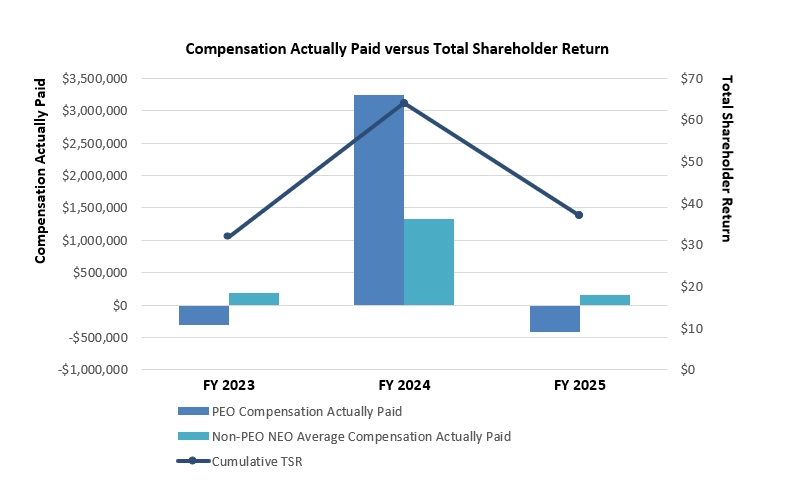
52
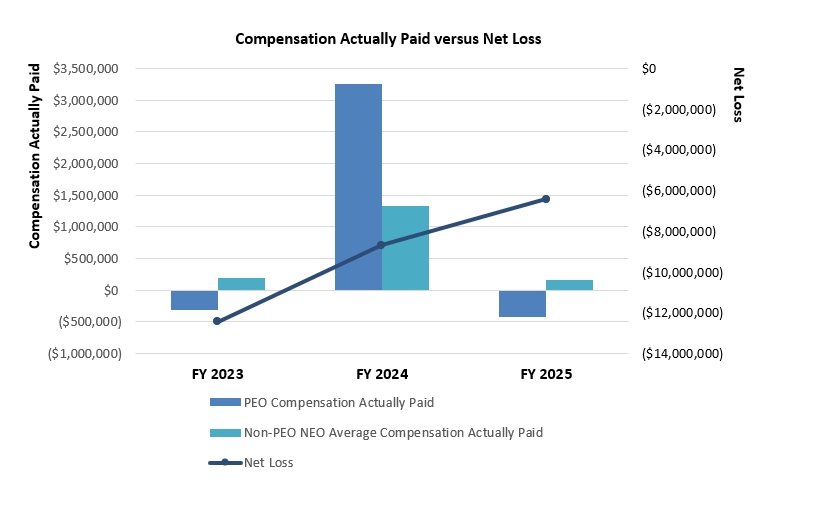
Equity Compensation Plan Information
As of December 31, 2025, we had four equity compensation plans in place under which equity awards were outstanding or shares of our common stock were authorized for issuance detailed as follows:
Plan Category |
Number of securities to be issued upon exercise of outstanding options and rights |
|
|
Weighted-average exercise price of outstanding options |
|
Number of securities remaining available for future issuance under equity compensation plans (excluding securities reflected in column (a)) |
|
|
|||
|
(a) |
|
|
(b) |
|
(c) |
|
|
|||
Equity compensation plans approved by security holders |
|
2,951,348 |
|
(1) |
$ |
9.22 |
|
|
773,704 |
|
(2) |
Equity compensation plans |
|
351,527 |
|
(3) |
$ |
7.91 |
|
|
639,846 |
|
(4) |
(1) Includes 2,114,440 shares of common stock that were subject to option awards and 811,243 shares of common stock that were subject to RSUs, under the 2016 Plan and the 2013 Equity Incentive Plan.
(2) Includes 123,116 shares of common stock available for issuance under the 2016 Plan and 650,588 shares of common stock available for issuance under our Employee Stock Purchase Plan (all of which were eligible to be purchased during the offering period in effect under the Employee Stock Purchase Plan on such date). This amount does not include any additional shares that became available for future issuance under the 2016 Plan or the Employee Stock Purchase Plan pursuant to the automatic increases to the share reserves under such plans on January 1, 2026.
53
(3) Represents 276,571 shares of common stock that were subject to option awards and 74,956 shares of common stock that were subject to RSUs under the Inducement Plan. The material features of our Inducement Plan are more fully described in Note 11 to the financial statements included in our Annual Report on Form 10-K for the year ended December 31, 2025, and filed with the SEC on February 26, 2026.
(4) Represents shares remaining available for issuance under the Inducement Plan.
We describe below the transactions and series of similar transactions, since January 1, 2024, to which we were a party or will be a party, in which the amounts involved exceeded or will exceed $120,000 (or, if less, 1% of the average of our total assets at year-end for the last two completed fiscal years), and in which any of our directors, executive officers or, to our knowledge, beneficial owners of more than 5% of our capital stock or any member of their immediate family had or will have a direct or indirect material interest, other than equity and other compensation, termination, change in control and other arrangements, which are described under “Executive Compensation and Other Information” and “Proposal 1—Election of Directors—Director Compensation” and above.
Indemnification
Our amended and restated certificate of incorporation and our amended and restated bylaws provide that we will indemnify each of our directors and officers to the fullest extent permitted by the Delaware General Corporation Law. Further, we have entered into indemnification agreements with each of our directors and officers, and we have purchased a policy of directors’ and officers’ liability insurance that insures our directors and officers against the cost of defense, settlement, or payment of a judgment under certain circumstances.
Policies and Procedures Regarding Related Party Transactions
Our Board has adopted a written related person transaction policy setting forth the policies and procedures for the review and approval or ratification of related-person transactions. This policy covers, with certain exceptions set forth in Item 404 of Regulation S-K under the Securities Act, any transaction, arrangement or relationship, or any series of similar transactions, arrangements or relationships in which we were or are to be a participant, where the amount involved exceeds $120,000 (or, if less, 1% of the average of our total assets at year-end for the last two completed fiscal years) and a related person had or will have a direct or indirect material interest, including, without limitation, purchases of goods or services by or from the related person or entities in which the related person has a material interest, indebtedness, guarantees of indebtedness and employment by us of a related person. In reviewing and approving any such transactions, our audit committee is tasked to consider all relevant facts and circumstances, including, but not limited to, whether the transaction is on terms comparable to those that could be obtained in an arm’s length transaction and the extent of the related person’s interest in the transaction. All of the transactions described in this section occurred prior to the adoption of this policy.
Stockholder Proposals
Proposals of stockholders intended to be presented at our annual meeting of stockholders to be held in 2027, including nominations of any person for election to our Board, must be received by us no later than December 31, 2026, which is 120 days prior to the one-year anniversary of the mailing date of the proxy statement for the 2026 Annual Meeting, in order to be included in our proxy statement and form of proxy card relating to that meeting, unless the date of the 2027 annual meeting of stockholders is changed by more than 30 days from the anniversary of our 2026 Annual Meeting, in which case the deadline for such proposals will be a reasonable time before we begin to print and send our proxy materials. These proposals must comply with the requirements as to form and substance established by the SEC in Rule 14a-8 of the Exchange Act for such proposals in order to be included in the proxy statement.
In addition, our amended and restated bylaws establish an advance notice procedure with regard to certain matters, including stockholder proposals and nominations of any person for election to our Board not included in our proxy statement, to be brought before an annual meeting of stockholders. In general, notice that meets the requirements set forth in our amended and restated bylaws must be received at our principal executive
54
offices not less than 90 calendar days nor more than 120 calendar days prior to the first anniversary of the preceding year’s annual meeting. Therefore, to be presented at our 2027 annual meeting of stockholders, such a proposal must be received by us no earlier than February 10, 2027, and no later than March 12, 2027. However, if the date of the annual meeting is more than 30 days before or more than 60 days after such anniversary date, notice must be received no earlier than the close of business on the 120th calendar day prior to such annual meeting and not later than the later of the close of business on the 90th calendar day prior to such annual meeting and the close of business on the tenth calendar day following the day on which public disclosure of the date of such annual meeting was first made. If the stockholder fails to give notice by these dates, then the persons named as proxies in the proxies solicited by the Board for the 2027 annual meeting may exercise discretionary voting power regarding any such proposal. Stockholders are advised to review our amended and restated bylaws which also specify requirements as to the form and content of a stockholder’s notice.
In addition to satisfying the foregoing requirements under our amended and restated bylaws, to comply with the universal proxy rules, shareholders who intend to solicit proxies in support of director nominees other than the Company’s nominees must provide notice that sets forth the information required by Rule 14a-19 under the Exchange Act no later than April 11, 2027, which is 60 days prior to the one-year anniversary of the date of the 2026 Annual Meeting.
We intend to file a proxy statement and WHITE proxy card with the SEC in connection with our solicitation of proxies for our 2027 annual meeting. Stockholders may obtain our proxy statement (and any amendments and supplements thereto) and other documents as and when filed by the Company with the SEC without charge from the SEC’s website at: www.sec.gov.
We reserve the right to reject, rule out of order or take other appropriate action with respect to any proposal that does not comply with these or other applicable requirements.
55
Annual Report
Any person who was a beneficial owner of our common stock on the record date may request a copy of our 2025 Annual Report and it will be furnished without charge upon receipt of a written request identifying the person so requesting a report as a stockholder of our Company at such date. Requests should be directed to Airgain, Inc., 3611 Valley Centre Drive, Suite 150, San Diego, CA 92130, Attention: Corporate Secretary. You also may access this proxy statement and our 2025 Annual Report at www.proxydocs.com/AIRG. We make available free of charge on our website all of our filings that are made electronically with the SEC, including our 2025 Annual Report. These materials can be found in the “Investors—SEC Filings” section of our website at www.airgain.com.
Stockholders Sharing the Same Address
The SEC’s rules permit us to deliver a single Internet Notice or set of proxy materials to one address shared by two or more of our stockholders. This delivery method is referred to as “householding” and can result in significant cost savings. To take advantage of this opportunity, we have delivered only one Internet Notice or one set of proxy materials to multiple stockholders who share an address, unless we received contrary instructions from the impacted stockholders prior to the mailing date. We agree to deliver promptly, upon written or oral request, a separate copy of the Internet Notice or proxy materials, as requested, to any stockholder at the shared address to which a single copy of those documents was delivered. If you prefer to receive separate copies of the Internet Notice or proxy materials, we will provide copies of these documents, free of charge, upon written request to Airgain, Inc., 3611 Valley Centre Drive, Suite 150, San Diego, CA 92130.
56
Attention: Corporate Secretary or by calling (760) 579-0200. Such requests by street name holders should be made through their bank, broker or other holder of record. Stockholders sharing an address that are receiving multiple copies of the Internet Notice can request delivery of a single copy of the proxy statement or annual report or Internet Notice by contacting their broker, bank, or other intermediary or sending a written request to Airgain, Inc. at the address above or by calling (760) 579-0200.
Delinquent Section 16(a) Reports
Section 16(a) of the Exchange Act requires our directors, executive officers and persons who own more than 10% of our Common Stock (collectively, “Reporting Persons”) to file with the SEC initial reports of ownership and changes in ownership of our Common Stock. Reporting Persons are required by SEC regulations to furnish us with copies of all Section 16(a) reports they file. To our knowledge, based solely on our review of the copies of such reports received, we believe that for the fiscal year ended December 31, 2025, all Reporting Persons complied with all applicable Section 16(a) filing requirements.
Other Matters
We do not know of any business other than that described in this proxy statement that will be presented for consideration or action by the stockholders at the 2026 Annual Meeting. If, however, any other business is properly brought before the meeting, shares represented by proxies will be voted in accordance with the best judgment of the persons named in the proxies or their substitutes. All stockholders are urged to vote their shares via the toll-free telephone number or over the Internet, as described in this proxy statement. If you received a copy of the proxy card by mail, we urge you to complete, sign, and return the accompanying proxy card in the enclosed envelope.
|
|
By Order of the Board of Directors, |
|
|
|
|
|
/s/ James K. Sims |
|
|
James K. Sims |
|
|
Chair of the Board of Directors |
|
|
|
San Diego, California |
|
|
April 30, 2026 |
|
|
57
58
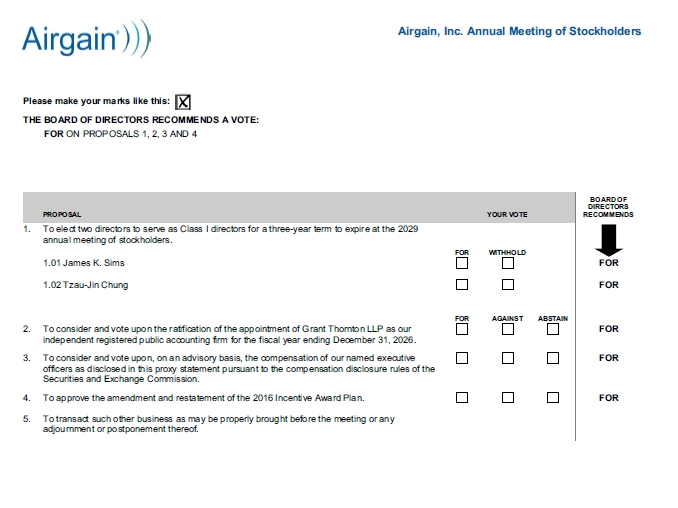
59
Appendix A
AIRGAIN, INC.
2016 INCENTIVE AWARD PLAN
(As Amended and Restated Effective June 10, 2026)
aRTICLE I.
Purpose
The purpose of this amended and restated Plan is to enhance the Company’s ability to attract, retain and motivate persons who make (or are expected to make) important contributions to the Company by providing these individuals with equity ownership opportunities. Capitalized terms used in the Plan are defined in Article XI. This Plan constitutes an amendment and restatement of the Airgain, Inc. 2016 Incentive Award Plan (the “Original Plan”) adopted by the Board on July 22, 2016 and approved by the stockholders of the Company on August 15, 2016, which became effective on August 11, 2016 (the “Original Effective Date”).
ARTICLE II.
Eligibility
Service Providers are eligible to be granted Awards under the Plan, subject to the limitations described herein.
ARTICLE III.
Administration and Delegation
ARTICLE IV.
SHARES Available for Awards
60
61
ARTICLE V.
Stock Options and Stock Appreciation Rights
62
ARTICL VI.
Restricted Stock; Restricted Stock Units
63
ARTICL VII.
Other Stock or Cash Based Awards
Other Stock or Cash Based Awards may be granted to Participants, including Awards entitling Participants to receive Shares to be delivered in the future and including annual or other periodic or long-term cash bonus awards (whether based on specified Performance Criteria or otherwise), in each case subject to any conditions and limitations in the Plan. Such Other Stock or Cash Based Awards will also be available as a payment form in the settlement of other Awards, as standalone payments and as payment in lieu of compensation to which a Participant is otherwise entitled. Other Stock or Cash Based Awards may be paid in Shares, cash or other property, as the Administrator determines. Subject to the provisions of the Plan, the Administrator will determine the terms and conditions of each Other Stock or Cash Based
64
Award, including any purchase price, performance goal (which may be based on the Performance Criteria), transfer restrictions, and vesting conditions, which will be set forth in the applicable Award Agreement.
ARTICL VIII.
Adjustments for Changes in Common Stock
and Certain Other Events
65
66
ARTICLE IX.
General Provisions Applicable to Awards
67
68
9.11 Dividend Limitations. Notwithstanding any other provision of the Plan to the contrary, dividends or Dividend Equivalents with respect to an Award that is subject to vesting that are based on dividends paid prior to the vesting of such Award shall only be paid out to the Participant to the extent that the vesting conditions are subsequently satisfied and the Award vests.
ARTICLE X.
Miscellaneous
69
70
71
ARTICLE XI.
Definitions
72
As used in the Plan, the following words and phrases will have the following meanings:
73
Notwithstanding the foregoing, if a Change in Control constitutes a payment event with respect to any Award (or portion of any Award) that provides for the deferral of compensation that is subject to Section 409A, to the extent required to avoid the imposition of additional taxes under Section 409A, the transaction or event described in subsection (a), (b) or (c) with respect to such Award (or portion thereof) shall only constitute a Change in Control for purposes of the payment timing of such Award if such transaction also constitutes a “change in control event,” as defined in Treasury Regulation Section 1.409A-3(i)(5).
The Administrator shall have full and final authority, which shall be exercised in its discretion, to determine conclusively whether a Change in Control has occurred pursuant to the above definition, the date of the occurrence of such Change in Control and any incidental matters relating thereto; provided that any exercise of authority in conjunction with a determination of whether a Change in Control is a “change in control event” as defined in Treasury Regulation Section 1.409A-3(i)(5) shall be consistent with such regulation.
74
75
76
77
* * * * *
78